
In the 8 to 9 figure Klaviyo accounts we audit, flows produce a large share of email revenue. They are also usually the part of the account that has gone longest without an edit.
Those two facts are related, and the bill lands in Q4.
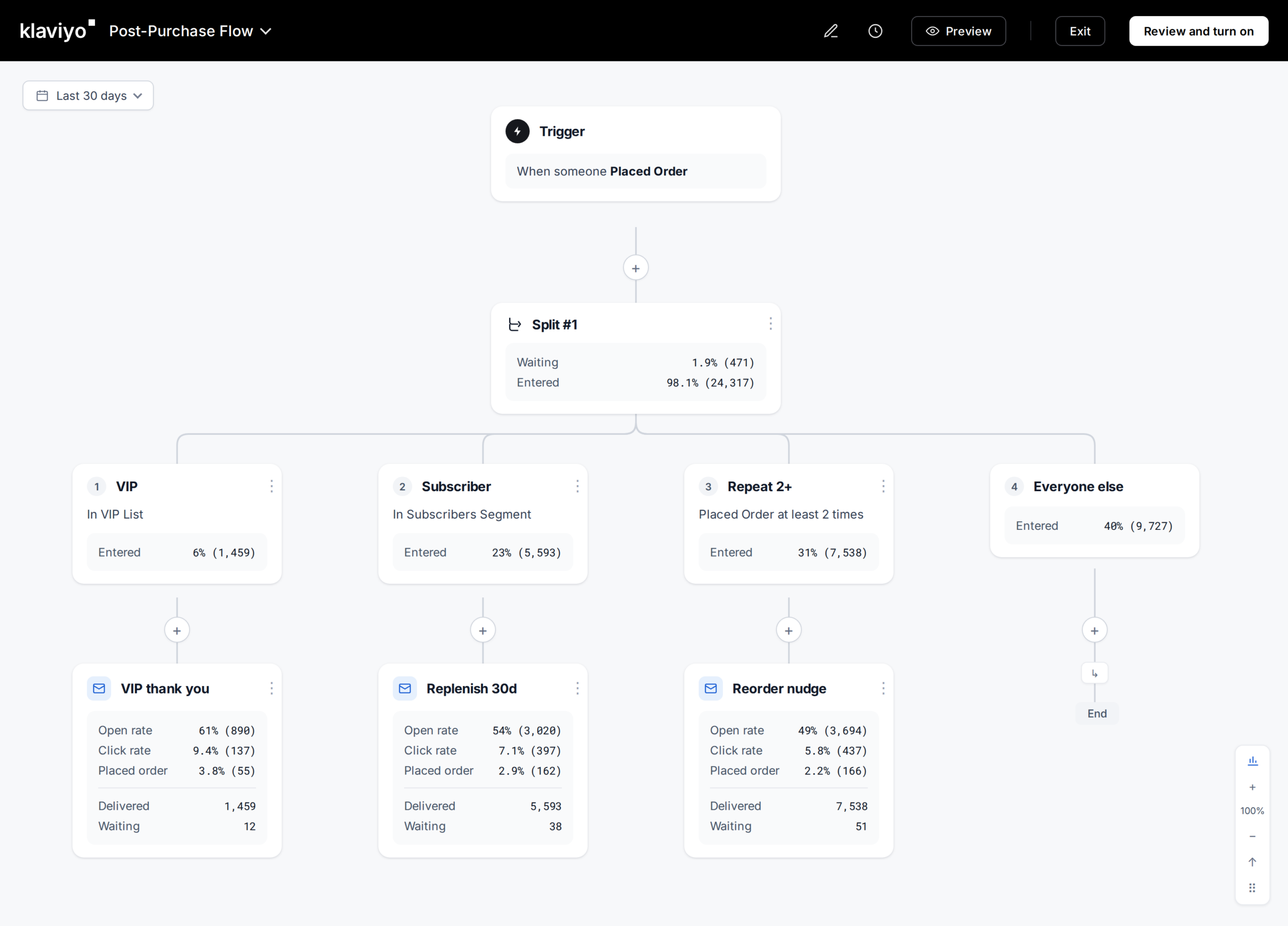
Klaviyo multi-branch splits were built for this. A single decision point sorts customers into as many as 20 paths, checked top to bottom, first match wins, with an Everyone else path that collects whoever is left. Klaviyo released it in phases, so it may already be sitting in your flow builder.
The flows you will lean on hardest in November are the ones nobody can confidently explain today. Most teams stop editing these flows before the holiday rush starts, so whatever is inside them, working or broken, is locked in through the most valuable weeks of the year.
And the cost does not stop in December. A logic error that survives Q4 keeps misrouting new buyers into January, and the lifetime value of your largest customer cohort of the year starts lower than it should.
We're a Klaviyo Master Elite Partner that has worked with 500+ DTC brands, and tangled flow logic is one of the findings we see most often in our audits. Rebuilding those long chains of yes/no decisions into single multi-branch splits belongs well before the freeze, while there is still room to test.
Why Is Tangled Flow Logic a Revenue Problem?
Once a flow forks five times, nobody on your team checks it anymore. Each yes/no fork doubles the number of places a customer can end up, and after two agencies and a few team changes, the logic map looks like a staircase falling off a cliff.
The first cost is silent failure: a branch built for a discontinued product, or an Everyone else path holding 40% of your customers with no message attached.
The second cost is fear. When logic is unreadable, your team stops proposing edits, and your highest-revenue flows become the part of the program that improves the least.
You have felt the symptom even if you have never opened the flow builder. Someone suggests an improvement in a meeting, and the answer is "let's not touch that flow right now." Multiply that answer across a year of meetings and the program stalls.
Fenix Lighting shows the scale. When we rebuilt their owned-channel program, flow revenue share grew 288% in 60 days, part of a shift that took owned channels from 23% to 71% of Shopify revenue by April 2023. Flows carry that kind of weight only when someone can actually work on them.
The flow trust test
When was your highest-revenue flow last edited, and by whom?
If the answer is "no idea" or "over a year ago," the logic inside it is probably the reason.
What Do Klaviyo Multi-Branch Splits Actually Change?
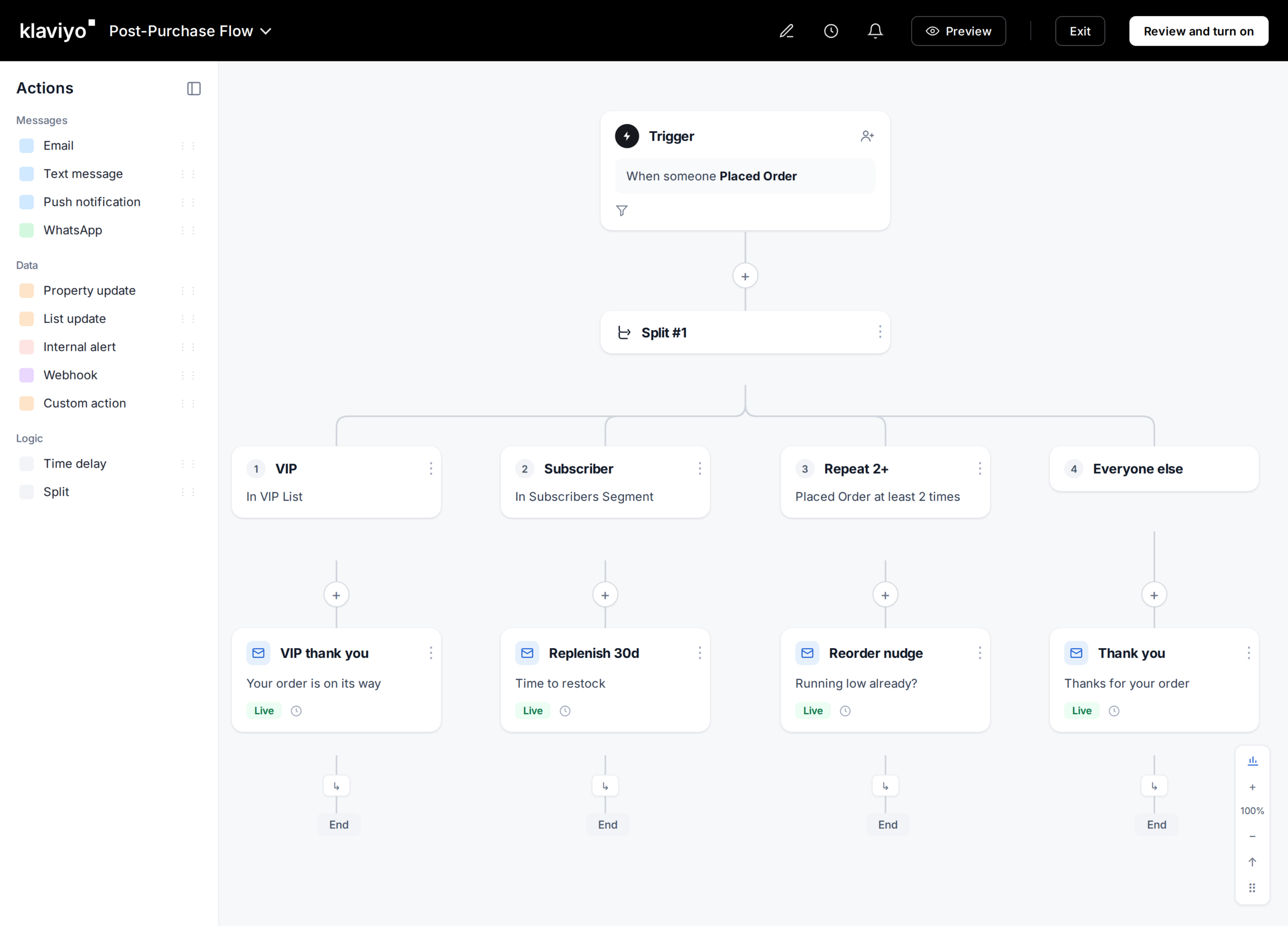
A multi-branch split is one decision point with up to 20 paths: 19 you configure, plus an Everyone else path that cannot be removed and always evaluates last. Klaviyo checks each customer against the paths in order, top to bottom, and sends them down the first path they match.
No customer ever goes down more than one path in the same split. That single rule is what makes the logic readable: anyone on your team can look at the split and say exactly where a given customer goes.
Each path can sort customers by almost anything Klaviyo knows about them: what they have bought, where they live, which list or tier they belong to, and even how likely they are to purchase again.
In practice, sorting that used to take four or five stacked yes/no splits now fits in one block your team can see at once. Language routing across five markets, or tier routing across your VIP levels: each becomes a single split your team can read at a glance and edit in seconds.
We built Qure's welcome flow on this kind of sorting. It separates first-time buyers from returning customers, splits US from international buyers for pricing and shipping, then routes each person by the skin concern they picked in the pop-up.
When Should One Split Replace Five?
Which sorting to collapse
Start with the sorting your flows already do in stages: by country, by customer tier, by product category, by how often the product needs replacing. If your abandonment flow forks by cart value and then forks again by purchase history, that is one multi-branch split, and the flow becomes something a new hire can understand on day one.
| What you sort customers by | How most accounts build it today | With one multi-branch split |
|---|---|---|
| Country or language | Four chained yes/no splits | One split, five paths |
| Customer tier | Three chained splits | One split, four paths |
| Product category | A separate flow per category | One split, up to 19 paths |
| Cart value band | Two or three chained splits | One split, four paths |
Path order decides who goes where
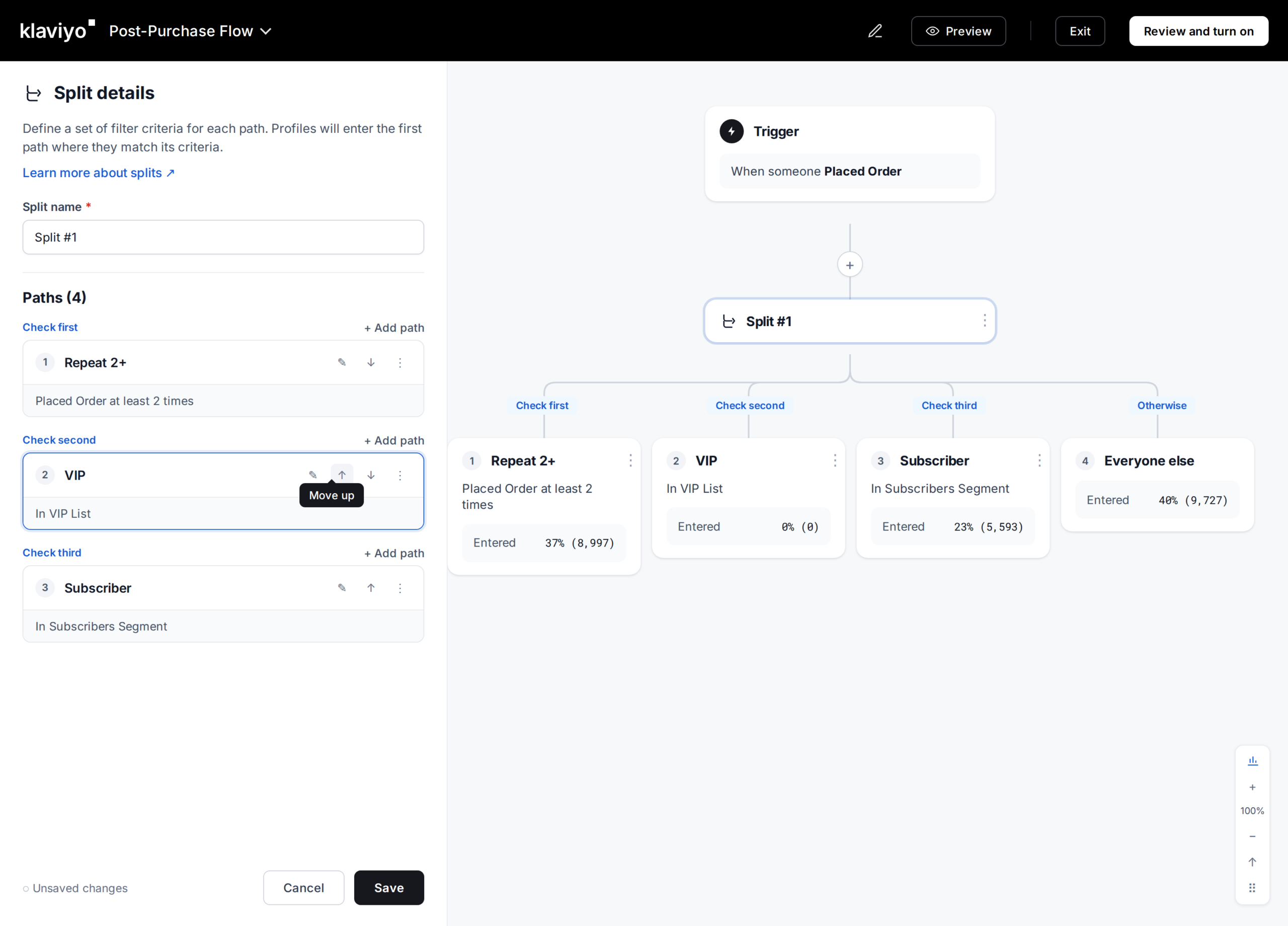
Ordering is the part to get right. Because the first matching path wins, the most specific conditions go at the top and the broadest near the bottom.
Get the order wrong and the flow lies to you. A VIP path placed below a "purchased more than once" path will never receive a single customer, and everything will look fine while your best customers get the generic treatment. Moving a path up or down changes who goes where, so the order deserves the same care as the conditions themselves, and a fresh look every time the split is edited.
When more paths stop paying
There is also a moment when more branching is the wrong answer. More paths only pay when each path gets a genuinely different message.
We took TexTale from one flow touchpoint to 13, and owned channels went from 9% to 30% of revenue year over year, on the back of recovery flows and tiered discounting. Every touchpoint we added had its own job in the journey. Twenty paths that all send the same email add complexity with no revenue attached.
What Does This Look Like Outside Q4?
Say the plan for the coming year is expansion into two new markets. The usual move is cloning the welcome and abandonment flows per market, and within a quarter your team is maintaining three versions of every flow, each drifting on its own.
One flow with a single split sorting customers by market replaces the clones. Every market keeps its own language and offers, and your team maintains one structure instead of three.
The stakes of getting multi-market lifecycle right are real. When we overhauled every flow across Cadenshae's markets in AU, NZ, CA and the US, email and SMS grew to 46% of total revenue, and a program only compounds like that when adding a market does not mean maintaining another copy of every flow.
The same structure covers a new product line launch, where one split routes buyers by category instead of cloning the flow per line. It covers a wholesale audience arriving in the same account, sorted by list membership at the top of the split so retail buyers never see trade pricing.
Why Is This a Q4 Decision You Make Now?
Peak season is when flows matter most and when editing them is most dangerous. That is why flow work sits early in any BFCM marketing strategy. The brands that win Q4 freeze their flow logic before traffic arrives, and a freeze only protects you if what you froze was correct.
The version of November you want is the boring one. The flow logic is locked, it has been read by everyone who owns it, and there is no 11pm Slack thread asking why VIPs received the entry-level offer.
The revenue riding on that logic is substantial. ALP Pouch's flows reached 49% of email revenue within four months of a rebuild, with recovery rates rising from 9.78% to 13.80%, against an industry average of about 3%.
Logic errors inside flows performing at that level do not announce themselves. Those flows just quietly recover less, all season. Rebuilding your worst tangled flows now, with the testing window still open, means your team enters November with flow logic they can read and defend.
Before Black Friday 2024, we mapped the flows EcoTraveller still needed and checked every trigger fired. Email went from 24% of its store revenue in November 2023 to 40% in November 2024.
The window that makes a Q4 freeze safe, counting back from Black Friday
-
10 weeks before Black Friday
Rebuild
Collapse the chained yes/no splits into single multi-branch splits. Name every path. Delete the branches built for products you no longer sell.
-
6 weeks out
Test
Check path order, because first match wins. Watch how many customers land in Everyone else, and give that group a message.
-
2 weeks out
Freeze
Logic locked before Black Friday traffic arrives. Your team spends peak season on offers and sends.
Ask your team Who last edited our highest-revenue flow, and can they explain where every customer goes?
If nobody can answer that, we'll map it with you.
Book a Free Strategy SessionKey takeaways
- One multi-branch split routes customers down up to 20 paths, and the first path a customer matches wins.
- Put the most specific conditions at the top and the broadest at the bottom.
- Give the Everyone else path its own message.
- Extra paths only pay when each one sends something different.
- Rebuild, test, then freeze your flow logic before Black Friday.
How We Approach Flow Architecture at Chronos
Flow logic is one layer of a lifecycle system, and we audit it the way an engineer reads code: every branch has to justify its existence with a distinct message and a measurable job.
Chronos Agency is an email, SMS and push retention agency and Klaviyo Master Elite Partner for 8 to 9 figure DTC brands, and our ecommerce email marketing team looks at flow architecture in every audit we run. The accounts where the logic stayed readable are the ones where the team kept improving it.
If you want an outside read on your flow logic before Q4, our Klaviyo email marketing agency team runs this as part of a full lifecycle audit.
Find Out Where Your Flows Are Leaking
Most brands cannot say which path a given customer takes through their highest-revenue flow, which is exactly how a branch ends up sending 40% of buyers nothing at all. A lifecycle audit maps the logic you already have, shows you where customers fall through, and gives you the rebuild order to run before peak season.
Book a Free Strategy Session →Frequently Asked Questions
What is a multi-branch split in Klaviyo?
A multi-branch split is a flow decision point that routes profiles down up to 20 paths from a single split, using conditions from Klaviyo's filter builder. Profiles are evaluated against the paths in order and follow the first path they match.
How many paths can a Klaviyo multi-branch split have?
Up to 20: 19 paths you configure plus an Everyone else path that catches all remaining profiles. The Everyone else path cannot be removed and always evaluates last.
Do multi-branch splits replace conditional splits?
They replace chains of conditional splits used for multi-way segmentation, such as routing by language, tier, or product category. A single yes or no decision is still a fine job for a regular conditional split.
What is the Everyone else path in a Klaviyo multi-branch split?
It is the mandatory catch-all path in every multi-branch split. Any profile that matches none of the configured paths goes down it, so no profile is ever left without a path.
Can a profile go down more than one path in a split?
No. Paths are evaluated top to bottom and a profile follows the first path whose conditions it meets, so path order determines routing.
When should you use a multi-branch split instead of separate flows?
Use one flow with a multi-branch split when the audiences share a trigger and a structure but need different messaging, like one abandonment flow routed by cart value. Use separate flows when triggers or goals differ.
Are multi-branch splits available in every Klaviyo account yet?
Klaviyo released multi-branch splits in phases. If the feature is not in your flow builder, Klaviyo sends an in-app notification once it is enabled for your account.
Ready to get started? Let's discuss how we can help your ecommerce business thrive.
Book a Free Strategy SessionRelated reading



Feature mechanics per Klaviyo's Multi-Branch Splits documentation.


