
For most DTC brands, a marketing holiday calendar is a checklist of dates to “go live” with a discount. For elite retention teams at the $15–50M ARR mark, that same calendar is a sophisticated blueprint for forecasting revenue, protecting margins, and engineering long-term customer LTV.
ata from the 2026 Adobe Analytics Holiday Report shows that while consumers spent a record $257.8 billion online last season, they are more price-sensitive than ever—making smart segmentation a survival requirement, not a luxury.
The dates on the 2026 holiday calendar are predictable; your revenue performance, however, is not—unless lifecycle strategy leads your planning. As we look toward 2026, the windows of opportunity are compressing. Inbox competition is at an all-time high, paid media costs continue to cannibalize CAC, and consumer decision cycles are shorter than ever.
The brands that will win in 2026 follow a specific hierarchy of operations: they segment before they discount, personalize before they promote, and automate before they scale.At Chronos, we believe holiday-led growth must be architected deep within your lifecycle stack. As a Klaviyo Master Elite partner, we don’t just help brands “send more email.” We design retention systems that turn seasonal spikes into sustained purchase velocity. The following guide is your playbook for transforming the 2026 calendar from a batch-and-blast schedule into a high-performance retention engine.
Major U.S. Holidays in 2026 with Revenue Planning Strategy
To win in 2026, you can’t treat every holiday like a clearance sale. Your calendar should be a balanced mix of high-intent “tentpole” events and strategic “micro-moments” that deepen customer relationships.
Below is the breakdown of the major holidays in 2026 and the retail holidays ecommerce brands must prioritize to maintain healthy margins while driving record growth.
Q1 2026 Key Holidays: The Reactivation Phase
The first quarter is often treated as a “cool down” after the Q4 frenzy. This is a mistake. Q1 is your prime window to turn the influx of holiday one-time buyers into loyalists.
- New Year’s Day — January 1, 2026: Beyond “New Year, New You” tropes, focus on reset campaigns, subscription pushes, and loyalty enrollment. It’s a massive reactivation moment for Q4 gift-getters who haven’t yet bought for themselves.
- Martin Luther King Jr. Day — January 19, 2026: Use this for brand values and community-centric messaging. Avoid “MLK Day Sales”—high-level DTC brands win here by standing for something, not discounting something.
- Valentine’s Day — February 14, 2026: Gift segmentation is your secret weapon. Are they buying for a partner, a friend, or themselves? Automated shipping cutoff reminders are critical here to prevent CX friction.
- Presidents’ Day — February 16, 2026: This is your first major promotional window of the year. Focus on product bundles to protect your Average Order Value (AOV) while clearing out post-winter inventory.
Easter — April 5, 2026: For family-focused verticals, early reminder flows outperform heavy last-minute discounting. Start your “Easter Basket” or family-gathering themes 3 weeks out.
Retention Lens: Q1 holidays should focus on reactivation and LTV acceleration. Stop relying on aggressive discounts and start using behavioral data to remind customers why they bought in the first place.
Q2 2026 Key Holidays: The Gifting & Summer Kick-Off
Q2 shifts the focus from personal resets to gifting and the start of outdoor seasonality.
- Mother’s Day — May 10, 2026: This is a high-stakes gifting holiday. Use advanced segmentation to target past Mother’s Day buyers and set up “Forgot Mom?” last-chance SMS workflows for the procrastinators.
- Memorial Day — May 25, 2026: Your first summer-scale promo window. This is a great time to test tiered offers (e.g., Spend $100, save 15%; Spend $200, save 25%) vs. flat discounts.
- Father’s Day — June 21, 2026: Cross-sell to your Mother’s Day purchasers. If they bought for Mom, they likely need something for Dad. Product bundles here are excellent for margin protection.
- Independence Day — July 4, 2026: This serves as a mid-year revenue checkpoint. Use it for loyalty activation—offer “Red, White, and Blue” exclusives or double points for VIPs.
Chronos Insight: This is where lifecycle orchestration meaningfully outperforms static campaigns. Logic-based flows in Klaviyo that adapt based on whether a user opened a Mother’s Day email but didn’t buy will drive 2x the ROI of a generic blast.
Q3 2026 Key Holidays: The Strategic Audit
Q3 is the calm before the Q4 storm. Use this quarter to clean your house and prepare your tech stack.
- Labor Day — September 7, 2026: Use this as your “End of Summer” inventory reset. It’s also the unofficial start of your Q4 list-building push.
- Back-to-School Season — July through September: Critical for apparel, beauty, and CPG. Early segmentation (targeting parents vs. students) beats last-minute urgency every time.
Strategic Move: Q3 is when disciplined brands audit their flows, deliverability, and segmentation depth. If your email deliverability is shaky in September, you won’t survive November.
Q4 2026 Key Holidays: The Peak Season
The “Super Bowl” of ecommerce. Success here is determined by the work you did in Q1–Q3.
- Halloween — October 31, 2026: Focus on engagement and list growth. Gamified “Trick or Treat” sign-up forms can rapidly expand your SMS list before Black Friday.
- Veterans Day — November 11, 2026: Use respectful, mission-driven positioning.
- Thanksgiving (Nov 26), Black Friday (Nov 27), and Cyber Monday (Nov 30): The core of the 2026 ecommerce holiday calendar. Our BFCM calendar 2026 maps these dates day by day. Early access tiers and predictive segmentation (targeting “Likely to Buy” segments) are non-negotiable.
- Hanukkah — December 4–12, 2026: Often overlooked; ensure your gifting logic includes this window.
- Christmas — December 25, 2026: Pivot to shipping cutoff flows and a heavy digital gift card push in the final 48 hours.
- New Year’s Eve — December 31, 2026: Deploy bounce-back offers to prevent the “January Slump.”
Retention Priority: Chronos consistently sees that brands who architect their automated flows early outperform those who rely on sheer campaign volume. Q4 is won through systems, not just “send” buttons.
For a granular look at omnichannel opportunities, you can also cross-reference Klaviyo’s interactive 2026 Marketing Calendar to identify high-potential SMS and email triggers.
Retail & Ecommerce-Specific Holidays in 2026
Beyond the traditional federal holidays, the “Retail Calendar” contains specific windows where consumer spending habits shift dramatically due to platform-driven events or community-focused movements. For a $15–50M brand, these dates are essential for maintaining share-of-mind when the digital landscape is most crowded.
Prime-Driven Shopping Windows (Estimated July 14–15, 2026)
Even if you don’t sell on Amazon, Prime Day creates a “rising tide” effect where consumer intent to shop is at a yearly high outside of Q4. In 2026, we expect the mid-summer event to land in the second week of July.
Instead of trying to out-discount the giant, counter-program with a retention-first strategy:
- VIP Segmentation: Use this moment to re-engage dormant segments. If they haven’t bought in 6 months, a “Members Only” mid-summer offer is the perfect hook before the Q4 noise begins.
- Loyalty Exclusives: Offer your “Inner Circle” or VIPs a deal they can’t find on a marketplace.
- Early-Access Offers: Start your “Anti-Prime” sale 24 hours early to capture budget before it’s spent elsewhere.
Small Business Saturday — November 28, 2026
Falling right between Black Friday and Cyber Monday, this is the moment to pivot from “deals” to storytelling. Consumers are often “discount-fatigued” by Saturday morning.
- Founder Narrative: Use high-engagement email content that features the humans behind the brand.
- Community Positioning: Highlight your local impact or brand mission.
Strategy: Shift from heavy discounts to “Gift with Purchase” or exclusive bundles that emphasize quality over price.
Giving Tuesday — December 1, 2026
This is your opportunity for cause alignment. After four days of “extraction,” use Giving Tuesday to build community equity.
- Transparency: Clearly state how a portion of proceeds supports a specific cause.
- Loyalty Participation: Allow customers to “donate” their loyalty points to a partner charity.
- The Goal: Community-building over pure revenue extraction. This builds the brand affinity that keeps customers coming back in Q1.
Industry-Specific “Micro Holidays”
Don’t clutter your calendar with every “National Cupcake Day,” but do lean into micro-moments that align with your vertical:
- Lunar New Year (January 28, 2026): Critical for brands with a global audience or specific gift-focused collections.
- Earth Day (April 22, 2026): Essential for sustainable or eco-conscious CPG brands to showcase supply chain transparency.
- St. Patrick’s Day (March 17, 2026): High-conversion opportunity for apparel and beverage brands through “limited drop” thematic products.
The Chronos Framework for Calendar Balance:
To avoid promotional fatigue and protect your brand equity, we recommend a 70/20/10 split:
- 70% Core Revenue Holidays: Major windows where aggressive sales are expected (BFCM, MDW, etc.).
- 20% Brand & Storytelling: Dates focused on loyalty, mission, and founder stories (Small Biz Saturday, Earth Day).
- 10% Strategic Experiments: Testing new channels (like a TikTok Shop exclusive) or “Micro Holidays” to see if they move the needle for your specific niche.
Best Campaign Types by Holiday (Lifecycle-First Playbook)
A high-performing 2026 marketing calendar isn’t just about when you send; it’s about what you send to whom. To scale a $15–50M brand, you must move beyond the “one-size-fits-all” blast and implement a lifecycle-first playbook.
At Chronos, we categorize holiday execution into three distinct phases: Pre-Holiday, During-Holiday, and Post-Holiday.
Pre-Holiday Campaign Strategy (60–90 Days Out)
The biggest mistake brands make is waiting until the week of a holiday to start communicating. The most profitable conversions happen because of the work done two months prior.
- VIP Early Access Segmentation: Identify your top 5% of customers by LTV and offer them “First Dibs” on holiday inventory. This builds exclusivity and secures revenue before competitors even launch.
- Predictive Churn Targeting: Use Klaviyo’s predictive analytics to identify customers “at-risk” of leaving. Re-engage them with personalized offers before the holiday rush begins.
- Lead Capture Optimization: 60 days out, pivot your pop-ups to focus on holiday-specific list growth. Offer “Early Notification” for BFCM or seasonal drops to capture high-intent traffic from paid ads.
- Execution Layer: This is the time for a technical audit. Ensure your Klaviyo segmentation is dynamic, your behavioral triggers are firing correctly, and your deliverability is primed for high-volume sending.
During-Holiday Campaign Strategy
When the holiday window opens, the goal is to maximize conversion while minimizing list fatigue.
- Tiered Offers by LTV Band: Not all customers deserve the same discount. Offer your “Whales” a deeper incentive or a high-value gift, while offering standard promotions to new prospects.
- Dynamic Product Recommendations: Instead of showing the same hero product to everyone, use Klaviyo’s dynamic blocks to show items based on their past browsing or purchase history.
- SMS + Email Cadence Control: Coordinate your channels. Use SMS for “Last Chance” urgency and Email for detailed product storytelling.
Authority Positioning: As a Klaviyo Master Elite partner, Chronos implements advanced segmentation logic and peak-volume deliverability safeguards. We ensure your emails land in the primary inbox—not the “Promotions” tab—even when every other brand in the world is hitting “Send.”
Post-Holiday Revenue Recovery Strategy
Most brands stop their efforts the moment the holiday ends. Elite retention teams know that the days following a major event are the most profitable for building long-term habits.
- Bounce-Back Offers: Send a “Thank You” email 48 hours after a purchase with a time-sensitive credit toward their next order (valid in 30 days). This bridges the gap between the holiday spike and Q1 stability.
- Subscription Upsell Sequences: For CPG or beauty brands, convert holiday one-time buyers into subscribers while the product is still top-of-mind.
- Review + UGC Flows: Automate the collection of social proof. High-quality reviews gathered in January will fuel your conversion rates for the rest of the year.
When Should You Start Planning Each 2026 Holiday?
Timing is the difference between a high-margin success and a frantic, “let’s just give 30% off” disaster. To hit the $50M ARR mark (or beyond), your planning cycle must be rolling—meaning as one holiday launches, the strategy for the next is already being stress-tested.
At Chronos, we break the 2026 marketing calendar into three distinct planning tiers based on the complexity and revenue potential of the event.
4–6 Months Before: The “Tentpole” Events (BFCM, Christmas)
This isn’t just about picking a discount; it’s about infrastructure.
- Offer Strategy Defined: Determine your “hero” offer. Is it a site-wide discount, a high-value Gift With Purchase (GWP), or a tiered “Buy More, Save More”?
- Inventory Forecasting: Work with your ops team to ensure your best-sellers have the depth to survive a 4x spike in volume.
- Full Lifecycle Audit: Review every automated flow (Welcome, Abandoned Cart, Post-Purchase) and update them with seasonal creative and logic.
2–3 Months Before: The “Mid-Tier” Windows (Mother’s Day, Memorial Day, Labor Day)
- Segmentation Logic Finalized: Who are the “past buyers” for this specific holiday? Who are the gift-givers vs. the self-shoppers?
- Creative Themes Locked: Get your design team moving on assets so your email and SMS creative feels cohesive with your site’s landing pages.
- SMS Compliance & List Health Check: Ensure your SMS opt-in rates are climbing and your deliverability is high before you ramp up send frequency.
30–45 Days Before: The “Micro-Holidays” & Strategic Moments
- Campaign Builds: Finalize the actual email and SMS drafts in Klaviyo.
- Leverage Existing Segments: Don’t reinvent the wheel; use the high-engagement segments you’ve been nurturing all year.
- A/B Testing: Test subject lines and offer framing on smaller “warm-up” sends to see what resonates before the main event.
The Chronos 3-Layer Holiday Planning Model
We advise our partners to view holiday planning not as a flat timeline, but as a three-dimensional architecture:
- Strategic Layer: This is where you set the revenue targets and margin guardrails. If you don’t know your break-even point on a discount, you aren’t ready to plan.
- Lifecycle Layer: This is the “engine room”—the flow readiness, segmentation depth, and automated triggers that do the heavy lifting while you sleep.
- Execution Layer: This is the “paint”—the creative, the copy, and the cross-channel orchestration.
The Reality Check: Brands that operate in the Execution Layer alone are forced to compete on price because they haven’t built the relationship. Brands that master all three layers—especially the Lifecycle Layer—are the ones that win on retention and sustainable growth.
Your 2026 Marketing Holiday Calendar Is a Retention Blueprint
The 2026 holiday calendar is fixed. The dates won’t change, the holidays will arrive on schedule, and your competitors will undoubtedly be in the inbox. What is variable is your lifecycle architecture. That is the engine that determines how much of that seasonal demand you actually capture—and more importantly, how much of it you keep.
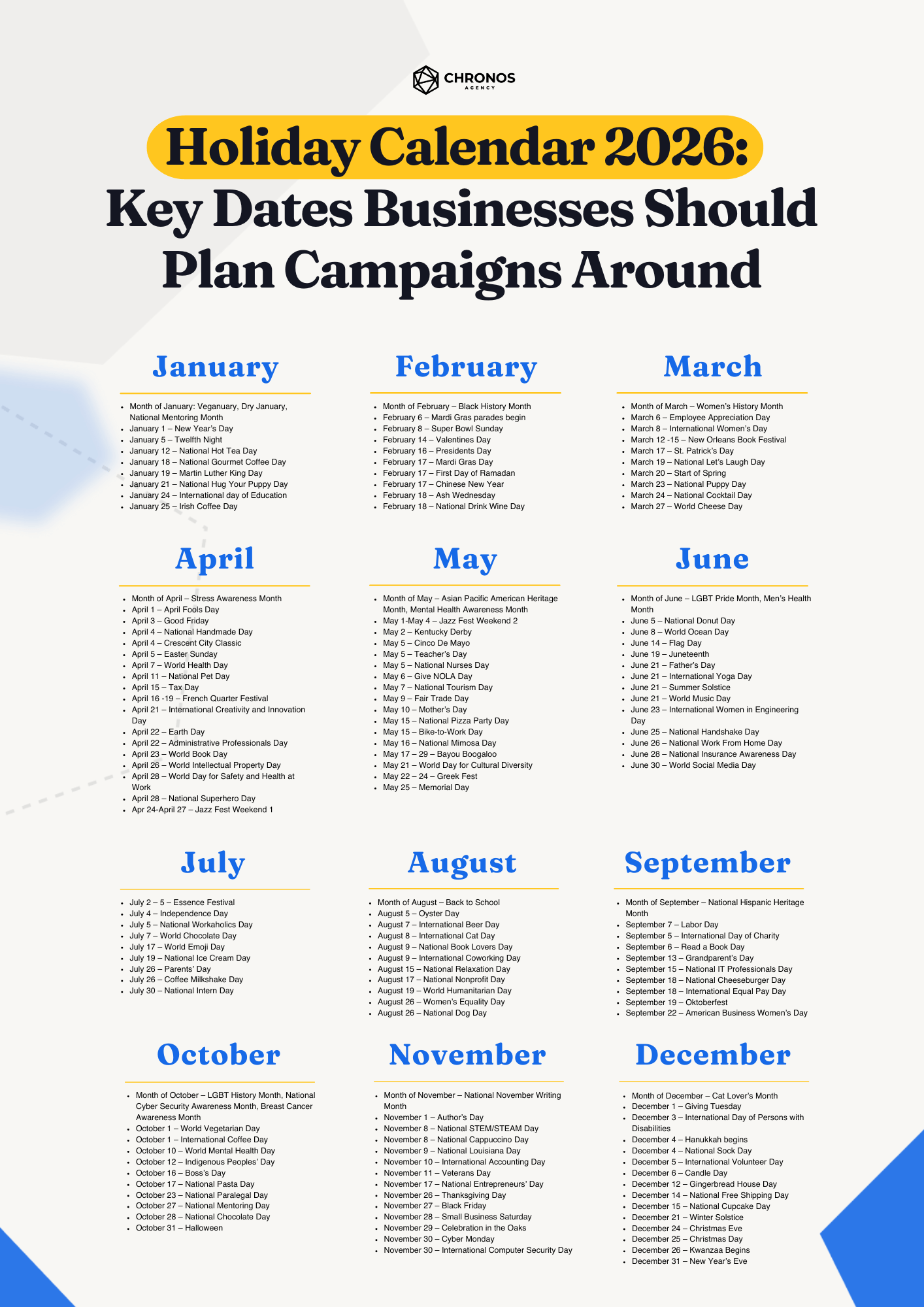
Keep a tab on these dates by downloading the calendar above.
Winning brands in 2026 won’t be the ones with the loudest subject lines; they will be the ones that:
- Plan with precision months in advance.
- Segment intelligently to protect their margins.
- Prioritize deliverability to ensure they actually reach the customer.
- Monetize post-holiday windows while everyone else is recovering.
At Chronos, we support $15–50M ecommerce brands by taking the guesswork out of the calendar. We design retention-first strategies, build advanced Klaviyo flow systems, and scale email and SMS revenue sustainably. Don’t let 2026 be another year of “batch-and-blast” anxiety.
Ready to stop running on the promotional treadmill?
Book a 2026 Holiday Lifecycle Strategy Session and let’s turn your marketing calendar into a predictable revenue engine.


