
fbpx Website Pop-Up 2026 Best Practices for eCommerce Brands
On this page

How Pop-ups Annoy Your Customers – And 5 Ways
To Fix Them

Many eCommerce brands are not short on traffic. They are short on conversion.

Visitors arrive, browse, and leave without taking action. Over time, that gap compounds into slower list growth, weaker retention, and higher pressure on paid acquisition. 

One of the earliest points where this leakage happens is the website pop-up.

Pop-ups shape a visitor’s first interaction with a brand. When they appear at the wrong moment or ask for too much too soon, they are ignored. When they are aligned with how people actually behave on site, they become a reliable entry point into email, SMS, and downstream revenue.

These patterns surfaced repeatedly in Chronos’ work with high-growth eCommerce brands and were discussed publicly when Chronos’ CEO joined Bringing Business to Retail, a podcast hosted by retail strategist Salena Knight. 

The observations shared there mirror what shows up in live storefront data: timing, structure, and intent alignment matter more than creative polish.

What follows breaks down how pop-ups perform in practice, using observed behavior and measured outcomes across Chronos-led experiments and lifecycle programs.

Why Pop-Ups Annoy Customers (And How That Hurts Conversion)

Pop-ups don’t annoy customers by existing. They annoy customers when they interrupt before value is established.

From a visitor’s point of view, the most frustrating pop-up experiences share the same traits:

  • They appear immediately, before the page has loaded or been understood
  • They demand attention without context
  • They repeat on every visit, even after dismissal
  • They obscure the content the visitor came to see

When this happens, the pop-up is perceived as friction, not assistance. The instinctive response is to close it as quickly as possible, often without reading a single word.

That behavior has downstream effects. Visitors who feel interrupted are less likely to engage further, less likely to trust the offer, and more likely to leave the site entirely. Over time, this reduces the effectiveness of pop-ups and weakens the first impression of the brand.

This is why pop-up performance is closely tied to timing and relevance. A message that appears too early feels intrusive. The same message shown after a visitor has explored products or content feels contextual.

Annoyance is not caused by the format. It’s caused by poor alignment with intent.

Understanding when annoyance happens makes it easier to understand why timing is the most important variable in pop-up performance.


Why Pop-Ups Commonly Underperform

Most pop-ups fail because they interrupt before visitors are ready.

Session data across multiple storefronts shows that non-converting visitors tend to exit within predictable windows. When pop-ups trigger immediately or without regard to that behavior, they are closed reflexively.

In one example discussed on the podcast, session analysis showed visitors leaving around the same point in their visit without purchasing. Adjusting the pop-up trigger to appear just before that drop-off window materially changed engagement.

“We saw visitors consistently leaving at the same point. Triggering the pop-up just before that exit made the difference.”
— Josh Chin, CEO & Co-founder, Chronos

This pattern appears across categories. Pop-ups perform when they respect attention, not when they race to capture it.

Pop-Up Best Practices That Actually Improve Conversion

Once the causes are clear, improving pop-up performance becomes straightforward. The sections below focus on the few variables that consistently change outcomes when tested on live eCommerce storefronts.

1. Timing Is The Primary Performance Driver

Timing determines whether a pop-up is even considered.

Across Chronos’ testing, three trigger types consistently outperform static, immediate pop-ups when applied intentionally:

  • Time-based triggers aligned to average session depth
  • Exit-intent triggers for early disengagement
  • Scroll-based triggers that allow product context first


The point is not which trigger is “best.” It’s whether the trigger is informed by real session behavior rather than guesswork.

2. Structure and Contrast Shape First Engagement

Once a pop-up appears at the right moment, structure determines whether it earns attention.

This showed up clearly in Chronos’ A/B testing for Kiyoko Beauty, where a full-page pop-up with a simple, curiosity-driven first step outperformed a standard modal across both the US and Canada.

Instead of immediately asking for an email, the pop-up opened with a single, lightweight question tied to product interest. That initial interaction created momentum before the form appeared.

The results were decisive:

  • US (Desktop):
    • Submit rate increased from 2.64% to 4.40 (+66.7%)
    • Orders increased from 14 to 27 (+92.9%)
    • Revenue per visitor increased by over 100%


  • Canada (Desktop):
    • Submit rate more than doubled (+105.3%)
    • Step-1 engagement exceeded 26%, translating into materially higher revenue


These outcomes came from improving first engagement, not increasing discounts or adding friction.
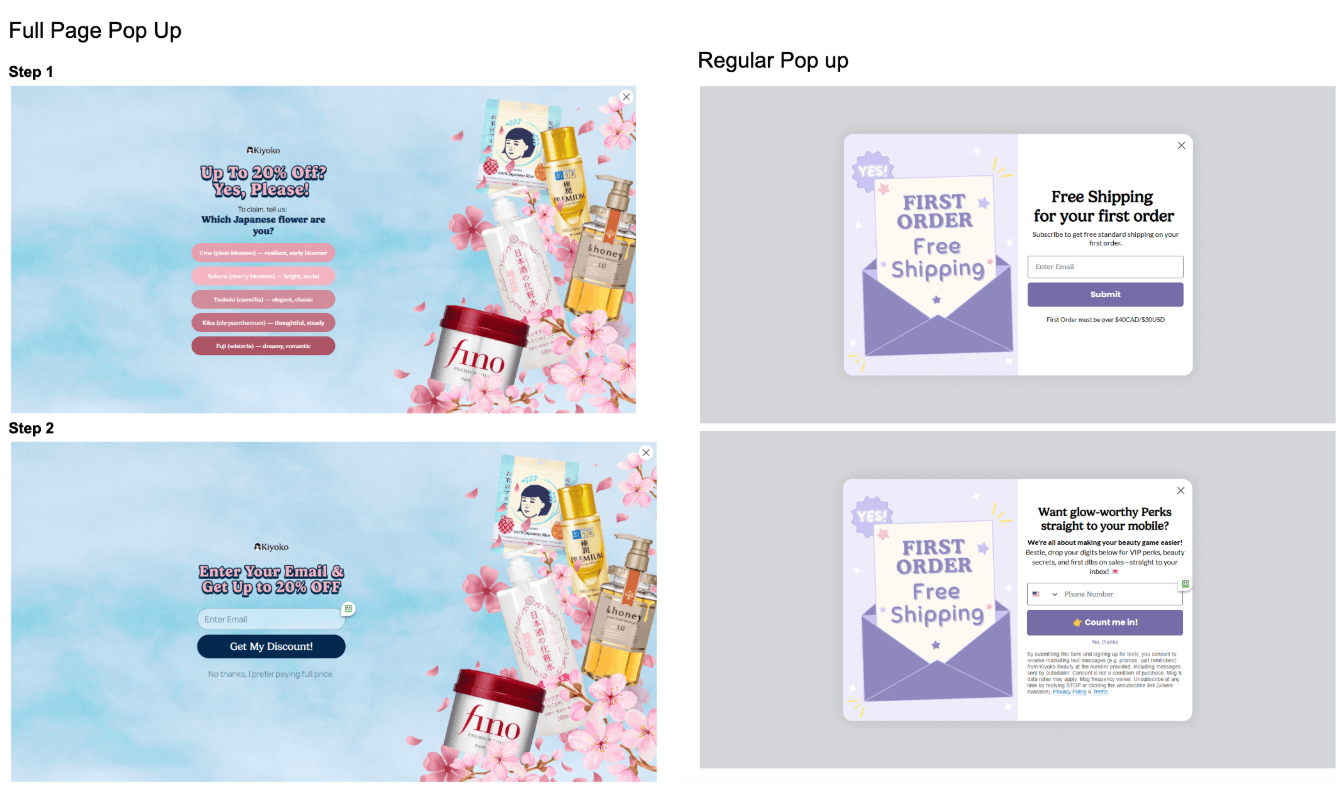
Kiyoko full-page pop-up vs standard pop-up comparison

3. Offer Value Needs To Match Intent

Offers influence conversion only once they cross a meaningful threshold.

Testing across Chronos clients shows that very small incentives the visitor has seen repeatedly fail to move behavior. At the same time, excessive discounts attract low-intent signups that underperform later in the lifecycle.

As discussed on the podcast, the shift happens when the offer feels materially worthwhile in context.

“There’s a point where someone who wasn’t going to buy becomes willing to consider it.”
— Salena Knight, Retail Strategist

The exact threshold varies by brand. What remains consistent is the need to evaluate offers based on downstream behavior, not just opt-ins.

4. Copy Should Reflect Why Someone Is There

Pop-ups perform better when copy mirrors visitor intent rather than announcing a promotion.

High-performing examples frequently open with prompts such as:

  • “Shopping for yourself or someone else?”
  • “Looking for a gift or something new?”


This framing slows the close reflex and invites engagement. The CTA becomes a continuation of the visitor’s thought, not an interruption.

5. Test Less, Learn Faster

Pop-ups present many variables. Most do not move results.

Across Chronos’ testing and client programs, performance gains consistently come from focusing on:

  • When the pop-up appears
  • What value is offered


Design and copy support these decisions. They rarely compensate for poor timing or misaligned incentives.

In the Kiyoko test, the winning variant did not introduce more variables. It focused on timing, first interaction, and offer alignment — and the data made the decision unambiguous.

6. First Interaction Should Reduce Form Friction

The strongest lift in the Kiyoko Beauty test did not come from visual changes alone. It came from delaying commitment.

In the full-page pop-up test, visitors were first asked a lightweight, curiosity-driven question before being shown an email or SMS field. That single interaction materially changed behavior.

In the US test, Step-1 engagement reached 11.67%, while final submission landed at 4.40%, compared to 2.64% on the standard pop-up. In Canada, Step-1 engagement exceeded 26%, more than the standard pop-up baseline.

The takeaway is straightforward:
When visitors take a small action first, they are more likely to complete the form that follows.

This pattern held across regions and translated directly into higher submit rates, more orders, and higher revenue per visitor. Reducing friction at the first interaction changed the outcome of the entire funnel.

WHY THIS MATTERS FOR REVENUE

Pop-ups influence the quality of the audience that enters your lifecycle.

When they are aligned with behavior, they increase list growth, improve engagement, and strengthen downstream performance across email and SMS. When they are misaligned, they quietly cap the return on traffic you are already paying for.

Chronos’ broader case work shows this compounding effect clearly, from engagement recovery at StopWatt to lifecycle-led revenue growth at brands like Kiyoko, The Oodie, and Fenix.

FAQ

Do pop-ups still work in 2026?
Yes. Brands that align timing, structure, and value continue to see strong performance.

What matters more: timing or design?
Timing. Design supports conversion once attention is earned.

Should returning customers see the same pop-ups?
No. Segmentation reduces fatigue and improves opt-in quality.

Are discounts required for pop-ups to convert?
No. Value can take many forms, but it must feel relevant and worthwhile.

FINAL TAKEAWAY

Pop-ups are not a cosmetic layer. They are an interaction point.

When they appear at the right moment, ask the right thing, and respect how visitors behave, they become a reliable conversion lever. When they don’t, they become background noise.

The difference is not creativity. It is alignment.

Key Takeaways

Lifecycle marketing is responsible for the long-running and sustainable eCommerce success of many 7 to 8-figure brands.

Customer-centricity is key to future-proofing your DTC store.

Customer retention is more cost-efficient and overall presents a more long-term and sustainable growth solution for eCommerce businesses.

Leverage direct marketing channels to establish direct communication with your customers as well as bring forward products and services that they would be interested in.

Omnichannel marketing is important to help tie all your existing marketing channels together for a seamless and consistent customer experience.

Ready to get started?

Let’s discuss how we can help your eCommerce business thrive! Book a call today to discover the power of lifecycle and retention marketing for long-term growth.
Book a call

Ready to get started?

Let’s discuss how we can help your eCommerce business thrive! Book a call today to discover the power of lifecycle and retention marketing for long-term growth.
Book a call