TL;DR: The $1B Scaling Blueprint at a Glance
The Goal: Transform from a “Viral Product” into a “Permanent Brand” with a high-multiple exit.
The Framework: Move beyond “arbitrage” by systematizing operations and replacing yourself as the founder bottleneck.
The Survival Metric: At the $25M “Death Zone,” you must shift focus from First-Click acquisition to a Retention Fortress (Email & SMS) to protect your margins against trend fatigue.
The $25M ‘Death Zone’ is the revenue stage where Meta CPA rises faster than repeat-purchase rate, causing margins to collapse. Brands survive it by shifting spend from first-click acquisition to owned-media retention (email, SMS, list hygiene).
The Technical Moat: Fix your “Invisible” infrastructure, IP warming, DMARC protocols, and list hygiene to recover millions in “lost” revenue sitting in spam folders. The Result: Building a predictable, automated backend can double your business valuation from a 1.5x multiple (dropshipping tier) to a 4x+ EBITDA multiple (legacy brand tier).
By Joshua Chin, Co-founder & CEO of Chronos Agency (Klaviyo Master Elite Partner). Published July 2021, Updated: 2026
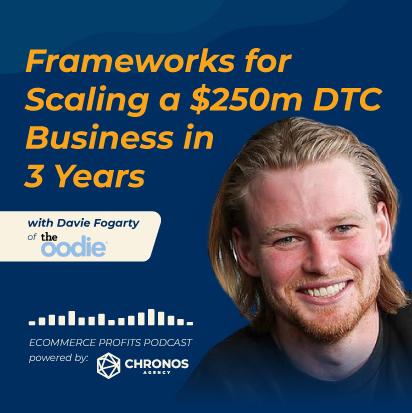
In the world of DTC, there is “growth,” and then there is the Davie Fogarty trajectory.

As the founder of the Davie Group and the mind behind The Oodie, Davie Fogarty transformed a string of early entrepreneurial failures into a global empire that has now surpassed $1 billion in total sales. Today, he is recognized as one of Australia’s most successful entrepreneurs, a judge on Shark Tank Australia, and a leading educator for the next generation of e-commerce founders.
But while Davie provided the vision and the frameworks for this hyper-growth, Chronos Agency provided the engine. As the specialized retention partner for Davie’s flagship brands, including The Oodie, Pupnaps, and Calming Blankets, we were responsible for building the technical infrastructure and lifecycle strategies that turned viral traffic into long-term enterprise value. We didn’t just watch these brands scale; we executed the email and SMS systems that captured the demand.
This guide is not just a look back at a legacy podcast episode. It is a modern synthesis of the $1B blueprint: the original strategic “gold nuggets” from Davie Fogarty, paired with the real-world execution data from the Chronos Agency team.
The Davie Group: A Portfolio of $1B+ DTC Brands
- The Oodie: Scaled to $250M+ with a 234% increase in email-attributed revenue.
- Pupnaps: Achieved a 2x revenue increase via lifecycle systematization and a 76% revenue spike after fixing technical deliverability.
- Calming Blankets: Increased email revenue from 27% to 45% of total store revenue, with email flows specifically contributing 31%.
The Proof: Real-World Execution
- Case Study: The Oodie’s $250M+ Scaling Journey
- Case Study: How Pupnaps Doubled Revenue via Lifecycle Optimization
- Case Study: Calming Blankets’ Foundation for Global Growth
- Case Study: Recovering Millions in “Lost” Revenue via Deliverability







Escaping the $1M–$10M Hustle: The Davie Fogarty Systematization Framework
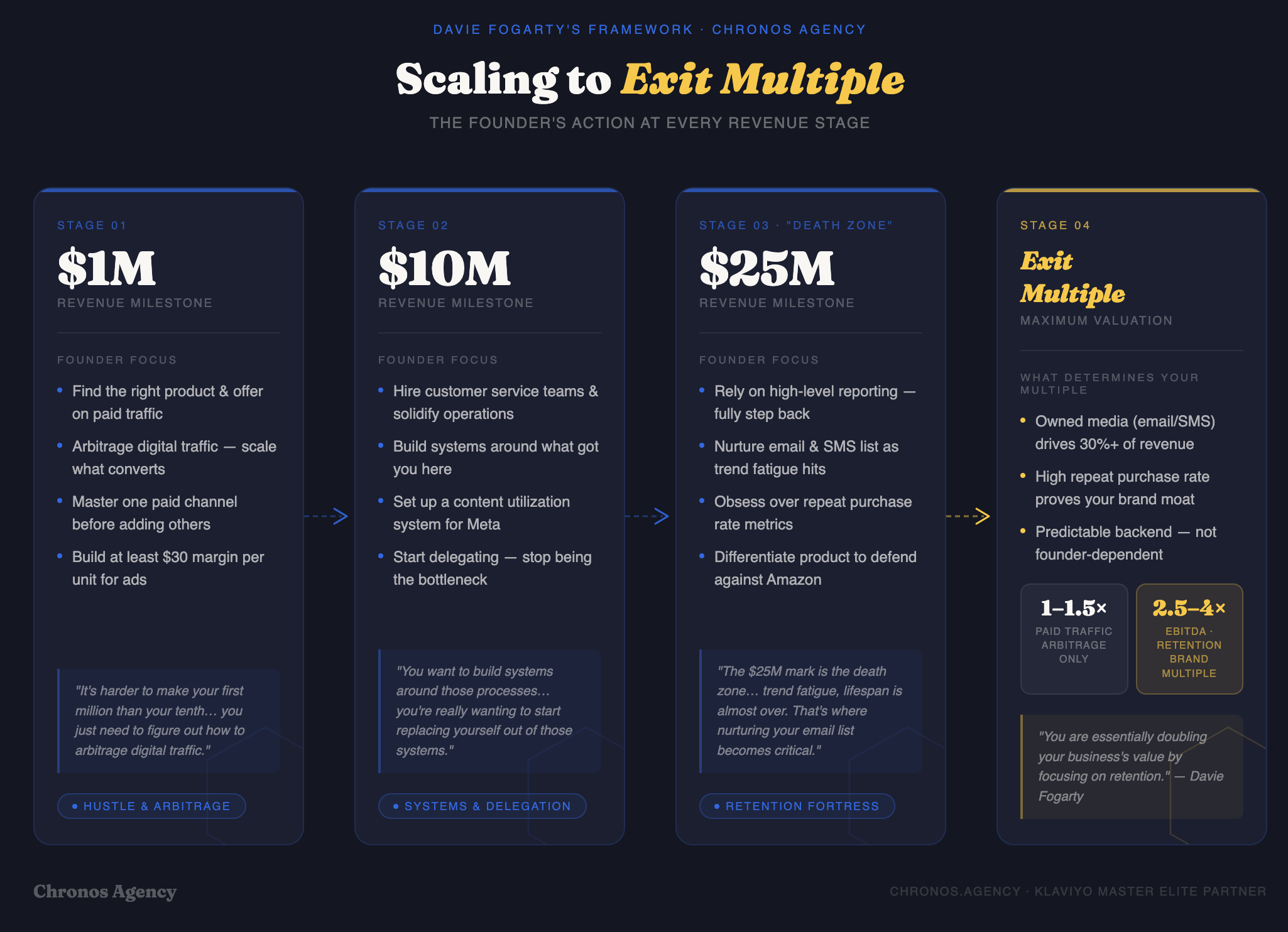
Reaching your first million is a feat of pure hustle. You found a product, you hit “play” on Meta, and you rode the arbitrage wave. But as you push toward $10M, that wave starts to crash.
This is where most founders get trapped. You’re working 18-hour days, approving every creative, and manually launching every campaign. You haven’t built a business; you’ve built a high-paying, high-stress job where you are the bottleneck.
Davie is blunt about this: the person you are at $1M is not the person who gets to $10M. If you don’t replace yourself with systems, the weight of your own growth will eventually crush you.
“To get to the $10 million mark… you’re obviously going to have to hire more eyes, or customer service teams, you know, get your operations really solid. You want to build systems around those processes that have gotten you there in the first place… you’re really wanting to start replacing yourself out of those systems.”
The Seasonal Trap: Why Your Cash Flow is Volatile
When you’re scaling a brand like Calming Blankets, you’re fighting a seasonal clock. When it’s cold, the sales come easy. But when the weather turns, your acquisition costs skyrocket, and your margins evaporate. If you’re still relying on one-off “seasonal” sales to survive, you’re dead in the water by June.
To cross the $10M line, you have to stop obsessing over the First Click and start obsessing over the Owned Revenue. You need a backend that keeps the lights on during the “off-season” so you aren’t starting from zero every morning.
Building the “Always-On” Revenue Engine
When we took over the retention for Davie’s brands, the goal wasn’t “pretty emails.” It was about building a department that generates revenue 24/7 without you needing to touch it.
As a Klaviyo Master Elite Partner, we have access to data architecture that most agencies don’t even know exists. We stopped treating email like a digital flyer and started treating it like a predictive revenue engine. We moved away from “Batch and Blast” campaigns and focused on:
- High-Intent Behavioral Triggers: If a customer lands on your site three times in a week but doesn’t buy, they shouldn’t get a generic newsletter. They should get a dynamic offer based on exactly what they were looking at.
- Zero-Party Data Integration: We don’t guess what your customers want; we build systems that ask them. By tagging every customer based on their specific needs, Are they buying for anxiety? Better sleep? As a gift?. We automate the exact right pitch at the exact right time.
- Customer Win-Backs: We built segmented “Re-engagement” flows that targeted past buyers who hadn’t touched the brand in 6 months, pulling them back into the ecosystem without spending a cent on Meta.
The Proof: How Calming Blankets Found “Lost” Profit
When Calming Blankets hit the $10M mark, they needed a backend that didn’t rely on the “winter rush.” We didn’t just “fix” their email; we optimized the entire Customer Journey to ensure a stable, year-round revenue driver.
- The Strategy: We moved away from “sale” fatigue and focused on value-based educational content, social proof, and hyper-segmented flows. By optimizing their Welcome and Cart Abandonment series, we targeted high-intent customers to catch every possible conversion.
- The Result: We didn’t just increase sales; we helped email become a massive profit engine, contributing 45% of their total store revenue. Specifically, automated email flows, which were originally targeted to hit 20%, reached 31% of total store revenue, providing the steady cash flow needed to scale globally regardless of the season.
The Takeaway: You Are the Bottleneck
If you are still the one driving your brand’s retention efforts, you aren’t scaling, you’re just busy. To cross the $10M line, you have to hand the keys to experts who live in the data. You provide the vision; the systems provide the scale.
Surviving the $25M “Death Zone”: Turning Viral Trends into Permanent Brands
If you’ve hit $25 million in revenue, you’ve likely caught lightning in a bottle. But this is where the air gets thin. Davie calls this the “Death Zone.” It’s the point where “Trend Fatigue” sets in every potential customer has seen your ads, your frequency is through the roof, and your Meta CPA is climbing every week.
At this scale, you can no longer outrun a high churn rate with more ad spend. If you aren’t selling to the customers you’ve already paid to acquire, your margins will vanish, and the brand will eventually fold.
The Trend Fatigue Trap
When a product goes viral, like The Oodie did, you face a unique problem: saturation. Once you’ve reached everyone on the “interest” level, your cost per acquisition (CAC) begins to skyrocket. Davie describes the shift like this:
“The $25 million mark is kind of like the death zone for a lot of e-commerce brands… the trend fatigue, the lifespan is almost over. That’s where you could obviously shed a lot of insights around nurturing that email list.”
To survive, you have to transition from a “Viral Product” to a “Permanent Brand.” That transition happens entirely on the backend. You need a Retention Fortress, a system that ensures every customer who buys once is mathematically driven to buy again.
The Valuation Reality Check
Many founders at this stage think they’re rich because of their top-line revenue, but Davie points out that the quality of that revenue determines what the business is actually worth. If you’re just “monetizing paid traffic,” you’re building a house of cards.
“I think the easiest way is to look at the drop shipping valuations… they’re getting 1 to 1.5 times multiple. And that’s just proof that there is no real value there. It’s just monetizing paid traffic.”
If you want a real exit, you need a brand that people actually care about, one where they come back without you paying for the click twice.
The “Oodie” Blueprint: Scaling to $250M with 43x ROI
When we partnered with Davie to handle the retention for The Oodie, we weren’t just managing an email list; we were managing a global data asset across multiple regions (AU, UK, US). At this volume, a 1% mistake in segmentation costs millions.
As a Klaviyo Master Elite Partner, we don’t look at Klaviyo as an “email tool”, we use it as the brand’s central nervous system. We moved beyond basic “Abandoned Cart” flows and built a high-precision architecture that protected the brand’s profit during the Death Zone.
What we actually executed:
- Predictive Churn Modeling: We built flows that identify when a “Super-Fan” is losing interest before they stop opening emails, triggering a high-value re-engagement offer at the exact right moment.
- Omnichannel Synchronization: We synced email and SMS behavior so that a customer didn’t feel bombarded. If they opened the email, they didn’t get the SMS.
- Hyper-Regional Segmentation: We ensured localized relevancy. A customer in London wasn’t getting the same “Summer Sale” pitch as someone in Sydney.
The Results: 234% email-attributed revenue lift in portfolio bullet, 30%+ of total revenue
The Oodie didn’t just survive the $25M mark; it blew past it to $250M+.
“You actually generated more revenue [with email] than people in the country itself… generating like $1, $2 every single quarter or month per person that’s living in a certain country. I think that’s insane.” Joshua Chin
By making email responsible for over 30% of total revenue, we gave Davie the margin “moat” he needed. Even when Meta’s ad platform became a volatile mess, The Oodie remained profitable because their owned-media engine was a 43x ROI machine.
The Takeaway: Your List is Your Insurance
If you’re approaching $20M–$25M, you are in the Danger Zone. If you are still relying on a “Batch and Blast” newsletter strategy, you are sitting on a ticking time bomb. To survive, you need to turn your database into a predictable, high-yield asset.
As Davie says regarding the importance of backing yourself in:
“You just need to kind of have a bit of conviction in the long term vision of what you’re trying to build and go from there.”
Running a brand near the $25M mark? Book a free lifecycle audit and we’ll show you exactly where your retention backend is leaking.
The “Invisible” Scaling Engine: Why Technical Infrastructure is the Difference Between Profit and Burn
Most founders at the $10M–$25M mark are obsessed with “better creative” or “new channels.” They think scaling is about the front end. But as you grow, the biggest leaks in your business aren’t in your ads, they’re in your infrastructure. You can have the best product and the most viral creative in the world, but if your emails are landing in the spam folder, you are burning cash.
Davie’s advice is simple: stop chasing the “next big thing” and fix the foundation you already have.
“Maybe don’t get distracted by all the channels out there… focus on your landing page where you’re pushing that traffic to optimize that, before branching out to Snapchat, Pinterest, all of these other ones. I think that that’s quite important to kind of really execute and push that as far as it can go.”
The Silent Killer: Email Deliverability
When you’re small, deliverability is easy. When you’re sending to 5 million people, it’s a war. ISPs like Gmail and Yahoo are looking for any excuse to throttle your reach. If your “technical debt” catches up to you, meaning your IP reputation is poor or your signatures (DKIM/DMARC) aren’t verified up to 30% of your revenue-generating emails will never be seen.
Scaling brands often “outgrow” their basic setups. You might be using a shared IP that’s being penalized by other senders, or your list is so bloated with unengaged users that it’s dragging your open rates into the dirt.
We’ve covered the step-by-step process of securing your sender reputation and bypassing the spam folder in detail. Watch the full Deliverability Walkthrough here to see exactly how we audit a scaling brand’s infrastructure.
Finding “Found” Profit for The Davie Group
When we audited the infrastructure for brands like Calming Blankets and The Oodie, we didn’t just look at the designs. We looked at the code and the server reputation. We found that a significant portion of their automated revenue was being “leaked” because of technical hurdles that most agencies don’t even have on their radar.
“We’ve helped hundreds of brands generate over $400M+ in attributable revenue across 500+ DTC brands as a Klaviyo Master Elite Partner (one of ~50 globally).” Joshua Chin
What we actually fixed:
- IP Warming & Reputation Management: We moved the brands onto dedicated, “warmed” IPs to ensure they weren’t being punished for the sins of other senders.
- Deep List Hygiene: We didn’t just remove bounces; we implemented sunset policies that automatically removed users who were damaging the brand’s reputation with ISPs, which actually increased total revenue by boosting inbox placement.
- Infrastructure Verification: We locked down the DMARC and SPF protocols to ensure that every email sent was verified as authentic, preventing the “Promotions” tab trap.
The Proof: Recovering Millions in “Lost” Revenue
By treating email as a technical vertical rather than a creative one, we “found” millions in revenue that was already there it just wasn’t being delivered.
- The Strategy: We performed a forensic audit of their deliverability metrics. We found that for every 10% increase in inbox placement, we saw a direct, proportional spike in Placed Order Rate.
- The Result: This technical heavy lifting is what allowed the Davie Group to scale globally without their backend breaking. We didn’t need more traffic; we just needed the existing traffic to actually see the messages.
- Check out the Deliverability Case Study: How Fixing the Technical Backend Increased Revenue
The Takeaway: Optimize Before You Expand
If you’re looking for your next million dollars in growth, don’t look at TikTok or Pinterest. Look at your Inbox Placement. Every email that lands in “Spam” is a customer you paid to acquire who is now being ignored.
As Davie notes, scaling is about getting the “devil in the details”:
“YouTube’s just such a amazing area for basic fundamentals… the devil’s in the details when you start getting going to some of these like events… that give all of these kind of high level best practices for the current situation. That’s the stuff that you won’t get on YouTube.”
The Valuation Multiplier: Turning a High-Growth Store into a Billion-Dollar Legacy Asset
The final stage of scaling isn’t about the cash you take home this month; it’s about the multiple you receive when you eventually exit. Davie Fogarty is incredibly blunt on this point: if your business is just a way to monetize Meta traffic, you don’t own a brand you own an arbitrage play. Investors don’t buy “hustle”; they buy predictable, automated systems that function independently of the founder.
“I think the easiest way is to look at the drop shipping valuations… they’re getting 1 to 1.5 times multiple. And that’s just proof that there is no real value there… A proper e-commerce brand… are going to be looking more at 2.5 to 4 times EBITDA for their multiples. You’re essentially doubling your business’s value [through retention].”
The Math of a High-Multiple Exit
Retention is the primary variable that private equity firms and strategic acquirers look at to determine risk. A high repeat-purchase rate proves that your product has a “moat” and that the business can survive even if ad algorithms or privacy policies change tomorrow.
At Chronos, we view retention as an Equity Bonus. When we secure the backend for brands like The Oodie or Calming Blankets, we aren’t just increasing their monthly sales; we are moving their exit multiple from the “arbitrage” tier (1.5x) to the “legacy brand” tier (4x+).
The Valuation Formula:
Brand Valuation = EBITDA × (Base Multiple + Retention Weighted Score)
Building for the “End Game”
Whether you plan to exit in two years or ten, you should be building as if you’re selling tomorrow. That means owning your data, mastering your technical infrastructure, and ensuring your “Owned Media” (Email & SMS) is responsible for at least 30% of your total revenue.By building this “Retention Fortress” for the Davie Group, we helped turn viral sensations into investable assets that hold their value long after the initial trend fades. As Davie notes, the key to this level of scale is having the conviction to stick to a long-term operational vision:
“You just need to kind of have a bit of conviction in the long term vision of what you’re trying to build and go from there.”
Ready to build the same engine that powered The Oodie?
Don’t just read the frameworks execute them with the team that was in the engine room from day one. If you’re ready to move past the “Hustle” phase and build a billion-dollar retention system, let’s talk.
Book a Free Strategy Call and Lifecycle Audit
The $1B Blueprint: Davie Fogarty’s Top Scaling Mistakes & Lessons
Scaling a global empire wasn’t a straight line. Davie is incredibly open about the “expensive lessons” learned while building the Davie Group. If you are currently between $1M and $25M in revenue, these five pivots are the difference between a successful exit and a “Death Zone” collapse.
- Mistake 1: The “Hiring Up” Delay – One of Davie’s primary regrets was not hiring people who had already achieved the specific scale he was aiming for. If you hire an Operations Manager who hasn’t managed a global 3PL, they will draw knowledge from you rather than leading the way.
- Mistake 2: Ignoring Demand Management – Being sold out of stock cost the group millions in potential revenue. Once you pass $15M, a dedicated Demand Manager is no longer a luxury; it’s a role that pays for itself by preventing stock-outs.
- Mistake 3: Channel Distraction – Many founders jump to Snapchat, Pinterest, or YouTube too early. Davie’s “Anti-Distraction” principle is simple: Pick one channel that works (Facebook or TikTok), double down, and optimize your landing page to the absolute limit before branching out.
- Mistake 4: Narrow Product Margins – Launching a product without at least $30 of margin for advertising is a recipe for failure in the current Meta landscape. Without that buffer, your CPA will eventually eat your profit.
- Mistake 5: Underestimating Conviction – There were moments where Davie considered selling early due to systematic pressure. His final advice is to have conviction in the long-term vision; building a “legacy brand” takes more time and backend infrastructure than building a “viral trend”.
The Full Podcast Transcript
Read the full transcript
The Full Podcast Transcript
[0:04] The Retention Engine: Joshua Chin Introduces Davie Fogarty
Joshua Chin: Welcome to the eCommerce Profits Podcast, where we feature top founders and experts to take an in-depth look at the struggles and successes of growing profitable brands. I’m your host, Josh Chin.
This episode is brought to you by Chronos Agency. If you are a direct-to-consumer (DTC) ecommerce brand ready to scale and double your customer lifetime value (LTV) through retention marketing, Chronos is your partner. We have helped hundreds of brands scale profits with Email, SMS, and Mobile Push, generating an average 3500% ROI. We’ve worked with brands like Truly Beauty, Alive Skin, and today’s guest, the founder of The Oodie, Calming Blankets, and Pupnaps.
Today’s guest is Davie Fogarty, the nine-figure founder of some of the fastest-growing ecommerce brands. Since 2018, Davie and his group have generated over $200 million in Shopify sales. Davie, welcome to the show.
Davie Fogarty: Thanks so much for having me, mate.
[2:03] From iPhone Cases to Vietnamese Rolls: The Reality of Early Entrepreneurial Failure
Joshua Chin: Let’s start with your entrepreneurial beginnings. There’s an interesting story revolving around F&B and Vietnamese rolls. Tell us more about that.
Davie Fogarty: It’s been a crazy journey. I’ve failed probably more than most entrepreneurs. Since I was 14 or 15, I knew I wanted to own a business, so I launched every business I could think of. I tried selling iPhone cases, headphones, and even mixing seasonings in my shed — none of them worked. The funniest failure was a Vietnamese roll cafe in my local suburb. I spent two years trying to turn it into a franchise. Eventually, I learned the fundamentals of digital marketing, which led to the launch of The Oodie and Calming Blankets.
[3:29] Applying Digital Marketing Strength to Product Development
Joshua Chin: What did you learn from that Vietnamese roll shop that you still apply today?
Davie Fogarty: It was more about what I didn’t apply there. If I launched it today, I’d succeed because I now understand digital platforms and how to market a product. It comes down to product development — you need a unique offering that can go viral on digital platforms.
[5:19] The Mindset of Humility: Staying Behind the Scenes
Joshua Chin: One thing that stood out when we started working together was how humble you and your team are. What was the philosophy behind that?
Davie Fogarty: It took three years to start talking about our financials. We wanted to remain behind the scenes. Our results come from our paradigms around product development, ecommerce, and direct response marketing. That’s changing now because we want to help people and we are investing in and acquiring businesses.
[7:17] Resenting the “Flaunter”: The Psychology of Staying Humble
Davie Fogarty: When I was struggling and failing, I would see people flaunting things, and it didn’t make me feel good. There is an element of empathy to staying humble — I don’t want to be the people I used to resent. But there’s a fine line; you still want to be confident, proud, and share your team’s wins.
[9:17] Product Over Polish: Transitioning to Brand Building
Davie Fogarty: We were entirely bootstrapped, so we relied on direct response, high conversion, and positive cash flow to fund growth. But The Oodie is becoming massive because of the brand itself. A brand is the product experience, the packaging, the shipping, and the customer service — but primarily the product itself and how it solves a problem.
[11:29] The $1M to $10M Blueprint: From Arbitrage to Architecture
Davie Fogarty: It’s harder to make your first million than your tenth. To hit that first $1M mark, you just need to figure out how to arbitrage digital traffic. Once you hit that mark, the shift to $10M requires you to hire customer service teams and get your operations solid. You want to build systems around the processes that got you there.
[13:30] Surviving the $25M “Death Zone”
Davie Fogarty: From $10M to $25M, you need to start replacing yourself out of those systems and rely on high-level reporting. The $25M mark is the “Death Zone” for many e-commerce brands — this is where trend fatigue sets in. Nurturing your email list, getting high reviews, and obsessing over repeat purchase rate metrics becomes absolutely critical.
[15:28] The Valuation Reality: Dropshipping vs. Legacy Brands
Davie Fogarty: Dropshipping businesses get a 1 to 1.5x multiple because there is no real value there — it’s just monetizing paid traffic. A proper e-commerce brand with a nice 3PL, diversified channels, and repeat customers can look at 2.5 to 4x EBITDA for their multiples. You are essentially doubling your business’s value by focusing on retention.
[18:01] The Digital Education Gap: YouTube vs. High-Level Events
Davie Fogarty: YouTube is an amazing area for the basic fundamentals of ecommerce. But the “devil is in the details” when you attend high-level events — you get best practices for the current situation that you just won’t find on YouTube. I’ve been lucky to have mentors like Tobi Pearce, Nick Shackleford, Matt Orlic, and yourself.
[19:56] The “Anti-Passion” Framework: Why Data Beats Feeling
Davie Fogarty: Passion is overrated in the short term. Passion for a particular product isn’t helpful because it silos you into believing it will work, regardless of reality. I suggest getting passionate about learning in general and figuring out what works as a whole.
[21:38] The Road to 12 Brands: Learning from 8 Failed Businesses
Davie Fogarty: Probably six to eight failures before success. Now we have about 12 brands. The common theme in the failures was hacky, permissionless marketing. I had to learn how to build value, communicate product features and benefits, and understand what the customer is actually looking for.
[23:24] Hiring “Humble Experts”: Operations, Finance, and Demand Management
Davie Fogarty: It is critical to hire people who have already done exactly what you want to achieve. Key roles to hire early: Finance (you need more than a bookkeeper), Operations & Demand Management (if you’re doing over $15–$20M, you need a Demand Manager), and Marketing & Customer Service leads who can build out their own teams.
[26:09] The Founder Bottleneck: How to Let Go Safely
Davie Fogarty: Never completely let go straight away. Define what success looks like from the outset. If the person you hire can’t tell you what they should be communicating to you, that’s a red flag. You’ll know you’ve done the right thing when they “run away with it” — improving structures and initiating new ideas without you.
[32:22] The Future of DTC: TikTok Shops, Electric Logistics, and 4-Hour Delivery
Davie Fogarty: I am incredibly excited. My excitement stems from transportation and logistics — as electric vehicles reduce costs, 4-hour delivery will become the norm for top brands. The biggest game-changer is TikTok; it has more organic power than Instagram ever had. We are going to see billion-dollar brands built entirely on TikTok organic traffic.
[34:36] AI and Product Development: The Next Marketing Frontier
Davie Fogarty: I’m primarily interested in the product development and content creation side of AI. If we can use AI to generate content and then use real-time customer feedback to improve that content, marketing becomes an automated process.
[38:09] The Strategic Regret: Inventory, Investment, and Conviction
Davie Fogarty: Five mistakes: (1) Hiring people who hadn’t already achieved what I was aiming for. (2) Not hiring a Demand Manager fast enough — being sold out cost us millions. (3) Not taking on capital earlier. (4) Not believing in ourselves enough — almost sold out too early. (5) Launching products without at least $30 of margin for advertising.
[40:50] The “Always-On” Asset: Email and SMS as Building Blocks
Davie Fogarty: People often overlook the power of retention. They will spend a fortune on a fancy website but ignore their email list. I view Email, SMS, and CRM as permanent building blocks. Every incremental improvement to your Welcome Series or Abandoned Cart flow effectively lowers your CPA on Facebook.
[44:47] Final Advice: The “Anti-Distraction” Principle
Davie Fogarty: Don’t get distracted. Focus on one channel — whether it’s Facebook or TikTok — that you know works for your product. Double down on that and optimize your landing page to the limit before you even think about branching out to Snapchat or Pinterest.
Joshua Chin: Perfect. Davie, thanks for coming on the show. Where can people find you?
Davie Fogarty: YouTube and TikTok — just search for Davie Fogarty.