
Allbirds' Marketing Strategy, Broken Down
Allbirds closed every full-price U.S. store in January 2026. The website is now the only sales floor they have. We tracked their full lifecycle system from pop-up to checkout abandonment to find out if the digital engine is built to carry that weight.
Watch the Full Audit Session
Josh Chin walks through Allbirds' full email and SMS lifecycle system live, with screen recordings, audit timeline data, and channel-by-channel analysis.
When the stores close, lifecycle becomes the only sales team.
Before getting into the findings, it helps to understand exactly what kind of brand we're auditing, because the stakes of every gap identified here are unusually high right now.
Allbirds sold its entire shoe business for $39M. Then pivoted to AI.
We published this audit in early 2026. A few days later, Allbirds announced it had sold its brand, IP, and inventory to American Exchange Group, the firm behind Ed Hardy and Mudd, for $39 million. The company once valued at $4 billion sold its entire shoe business for less than most DTC brands raise in a Series A. The corporate shell rebranded as NewBird AI and announced a pivot to GPU compute infrastructure. Between 2022 and 2025, Allbirds' revenue fell from $298M to $152M.
This audit does not explain the full collapse. Trend cycles, rising CAC, and an increasingly crowded sneaker market all played a role. But the gaps documented here show what was missing when the floor fell out: no cart recovery flow, no SMS activation, no behavioral segmentation. The brand had extraordinary equity. The owned-channel engine was not built to match it.
Allbirds sits in a unique buying category. They are not replenishable, nobody runs out of wool runners every 30 days. But they are also not a single high-consideration purchase like a $400 cookware set where the entire lifecycle job is closing one big sale. The average Allbirds shoe runs $100 to $130. The barrier to a first purchase is relatively low.
So where does the real revenue live? Shoe number two, three, and four. The entire product strategy is built around this. Wool runners for the office. Tree Dashers for active days. Cruisers for weekends. Slip-ons for home. An elevated line for dressier occasions. A relaxed line for everyday wear. Six distinct product lines designed for six different moments in a customer's life. The lifecycle job is not restock. It is building the closet.
And then in January 2026, Allbirds closed every remaining full-price store in the United States. All of them. Forty-five locations at peak, now zero. The company went all-in on e-commerce. When physical stores exist, email and SMS play a supporting role. When those stores close, every welcome flow, every cart recovery, every campaign becomes the sales associate. There is no one else to save the sale.
Brand equity is not the same as owned-channel equity
The Wool Runner had Barack Obama and Leonardo DiCaprio wearing it. The brand story, merino wool, eucalyptus fiber, sugarcane sole, certified B Corp, was as strong as any in DTC. None of that protected the business when stores closed and paid CAC rose.
When the floor fell out, there was no lifecycle infrastructure to catch the customers who were already there. A cart recovery flow, an active SMS channel, and a welcome sequence that actually educated rather than just discounted, none of those were in place. Brand equity without owned-channel equity is a business that depends on its best days never ending.
The pop-up collects email and phone. It asks nothing else.
Allbirds fires their pop-up the moment the site loads. The structure is solid: a 3-step sequence that accepts the 15% offer, captures an email, and then asks for a phone number. Both channels collected in one flow. That is already a step ahead of many brands we have audited.
What they get right
✓ Both email and SMS collected at the front door
Most brands still only capture email at sign-up. Allbirds collects both in a single 3-step flow. The mobile experience renders cleanly and the brand feel is consistent throughout.
✓ Immediate fire, no delay
The pop-up fires on page load. For a brand with 1.2 million monthly visits, capturing intent at the highest attention moment is correct execution.
The gap
✕ Six product lines, zero questions
Every one of those 1.2 million monthly visitors enters the exact same funnel. Someone shopping for a casual wool slip-on gets the same journey as someone looking for a performance shoe for their commute. No preference question, no occasion prompt, no "what brings you here today." Every flow that follows is a guess.
✕ The pop-up is the only sales associate left
When there were stores, associates asked "what brings you in today?" within seconds. That question fed the rest of the conversation. The pop-up is the digital equivalent of that moment, and right now it hands out a coupon and walks away.


Guided buying converts better than informed discounting
We ran this exact test with Kiyoko Beauty, a brand with a similar challenge: high SKU count, real product differentiation, and a subscriber entering cold. Swapping a standard email capture pop-up for a guided quiz with one opening question drove a 66.7% lift in signups and a 116.7% jump in revenue in the U.S. In Canada, signups more than doubled and revenue climbed 81.8%.
The logic for Allbirds is identical. One question: "What's your day like?" with three or four occasion options. From that single answer, the welcome email shows a different hero product, browse abandonment flows know which category matters, and campaigns stop broadcasting the full catalog. That is the difference between collecting a subscriber and starting a customer relationship.
The account that learned nothing
After the pop-up, we created a full Allbirds account to see whether account creation would unlock any personalization or feed the lifecycle engine with additional data.
A name field, an email, and an address book. That is it.
Despite already collecting a phone number in the pop-up, the account creation page had no phone field. No shoe preferences, no wear occasion prompt, no style profile. Two opportunities to build a customer data profile, the pop-up and the account page, and both were left blank. Every touchpoint that follows is still flying without any signal about who this subscriber actually is.

The welcome email landed in Primary. Allbirds spent that advantage on a coupon.
One of the strongest deliverability signals we look for is whether a welcome email lands in Gmail's Primary inbox or gets routed to Promotions. Allbirds' welcome landed in Primary, that is a genuine competitive advantage that most brands do not have. What they do with that prime real estate is where it gets complicated.
The welcome email
✓ Welcome email lands in Primary inbox
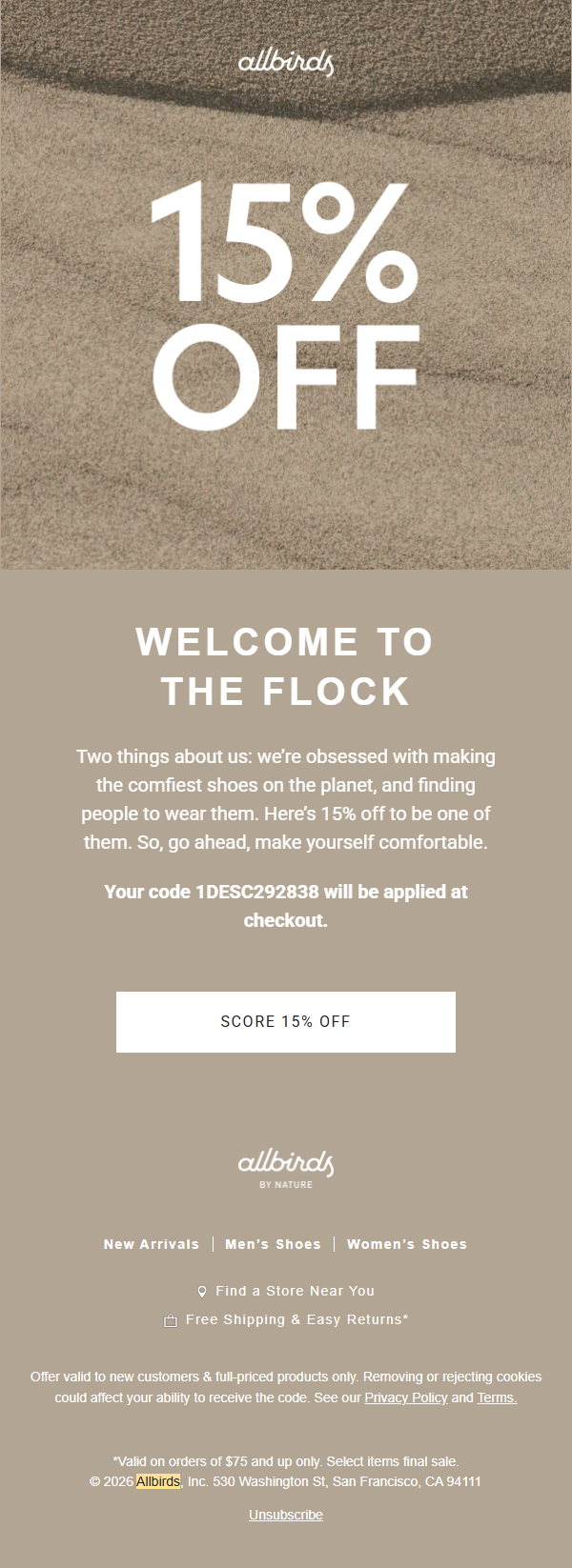
Subject: "Hey There, New Friend." Preview: "on orders of $75 and up only." For an email-heavy brand, Primary placement is prime real estate right next to personal messages from people the subscriber knows. Most brands with heavy image builds end up in Promotions. The welcome landing in Primary is a genuine deliverability win.
✕ Subsequent emails land in Promotions
The Primary advantage does not hold beyond the welcome send. Campaign emails, nurture sends, and the constant discount reminders in the first two weeks consistently land in Gmail's Promotions tab. For subscribers who never open that tab, the lifecycle conversation effectively ends after the welcome email.
✕ The welcome email is just a coupon
A large 15% OFF graphic taking up half the email. Two sentences of copy. A discount code. One CTA. The warm subject line "Hey There, New Friend" sets a tone the email never follows through on. Allbirds has one of the most compelling brand narratives in DTC, merino wool, eucalyptus fiber, sugarcane foam, a genuine sustainability story, and none of it appears here.
✕ Footer still says "Find a Store Near You"
Every full-price U.S. store closed in January 2026. The welcome email, every campaign send, every nurture email across the audit window carries a footer pointing subscribers to physical locations that no longer exist.
Prime real estate spent on a discount that was already in the pop-up
The subscriber already accepted the 15% offer in the pop-up. Repeating it in the welcome email as the only content wastes the Primary inbox advantage entirely. The welcome email for a brand with six product lines and a rich sustainability story should be doing real work: educating, guiding toward a first product, and building the case for why this subscriber should eventually own shoes across multiple lines.
Ten-plus emails sent. Not one acknowledged the cart existed.
Our audit methodology tests the full intent ladder, passive browse, cart add, return visit, checkout progression, and final abandonment. We want to see whether the system recognizes escalating intent and responds accordingly. With Allbirds, we tracked 17-plus days across two abandonment stages. Here is what the full timeline looked like.
No cart flow. No checkout flow. This is not a gap in settings.
We added products to cart, abandoned, and waited. We returned days later, progressed all the way through to the shipping step, entered full address details, and walked away. Over more than 17 days and 10-plus emails, not one message acknowledged the cart. Not one linked back to checkout. The recovery infrastructure does not exist, it is not misconfigured, it is absent. For a brand with no store associates left and a product line that requires the customer to come back multiple times to reach full LTV, this is the single most urgent structural fix.
2.5 weeks. Ten-plus emails. Zero texts.
Allbirds' pop-up collects a phone number. The account creation flow had additional touchpoints. We gave them every possible signal across the full audit window. The SMS channel was completely dark.
The consent is collected. The engine is off.
Here is every step we took to give Allbirds an opportunity to reach us via SMS, and what happened at each one.
No stores. No associates. No texts. The lock screen is the closest thing they have to a tap on the shoulder.
When physical stores existed, a missed email had a backup. An associate could reconnect with a returning customer. That option is gone. Email is competing in a crowded inbox. Some of those sends are already slipping into Promotions. SMS bypasses all of that, it hits the lock screen directly, it gets read within minutes, and at the cart and checkout abandonment stages, it converts at a higher rate than any re-engagement email.
The consent mechanism works. The list exists. The phone numbers were collected. The engine is simply not running.
What SMS activation looks like at a comparable scale
Cadenshae, a maternity activewear brand with a similar setup, strong email program, SMS completely untapped, activated SMS flows alongside their email program. Owned channels went from a minority contribution to 46% of total revenue. Email and SMS together, not email alone.
Olivia Jewelry rebuilt their SMS segmentation and layered it into automations and campaigns. In their peak selling months, SMS revenue was 10 times what it had been the year before. Not doubled. Ten times.
Allbirds has 1.2 million monthly visitors, a $190M revenue base, and an SMS list that was collecting consent throughout the entire audit window. The infrastructure is there. The channel is just switched off.
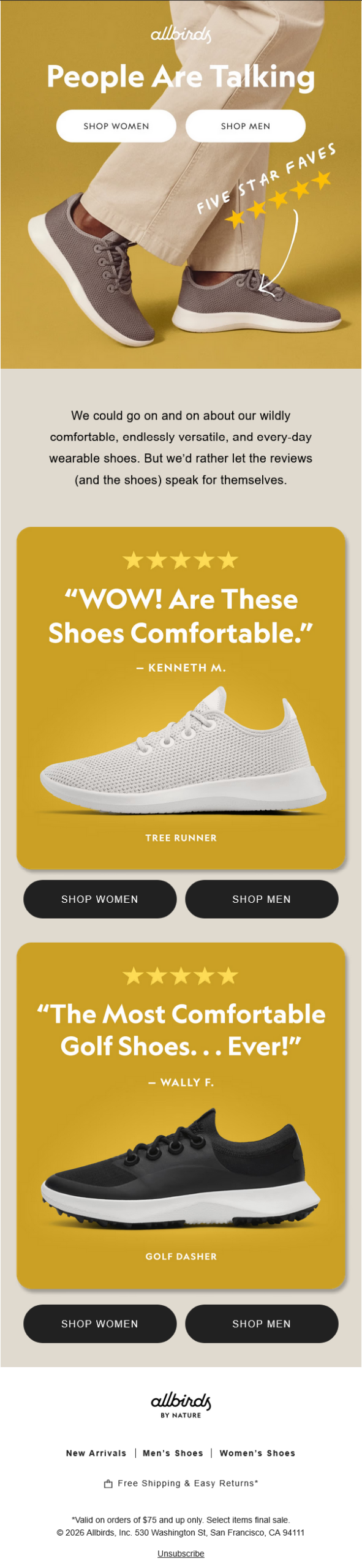
Strong creative. Same email to every subscriber.
Allbirds' campaign creative is genuinely good. The copywriting is sharp, the visual language is consistent, and the seasonal angles are well-executed. The structural gap is that every send, regardless of what a subscriber has browsed, carted, or purchased, goes to the full list without segmentation.
 Valentine's Day
 Holiday
Social Proof Push
Holiday
Social Proof Push
Six product lines built for six different moments. Campaigns treat every subscriber the same.
Every campaign during the audit window was a full catalog broadcast. New arrivals, gifting angles, seasonal drops, all sent to the full list regardless of browsing history, cart activity, or stated preferences. Nobody who browsed Tree Runners got a targeted follow-up about Tree Runners. The product strategy says "build a closet." The campaign engine says "here is everything we sell, good luck."
No campaign in the audit window was paired with SMS. The Valentine's push, the holiday collection, the product launches, all email-only. One channel doing the work of two.
The brand is strong. The lifecycle infrastructure is not ready for what the business just became.
Allbirds has a real brand story, a loyal base, and a product strategy built for long-term LTV. The creative output across campaigns holds up against anyone in DTC. The infrastructure gaps we found are not about the brand. They are about the systems sitting underneath it.
Six product lines, zero data collected
The pop-up collects email and phone but asks nothing. No preference question, no occasion prompt, no segmentation signal. Every flow that follows is a guess across a brand with six distinct product lines for six different moments in a customer's life.
2.5 weeks, zero texts
Despite collecting explicit SMS consent, creating an account, and triggering every major behavioral signal including checkout abandonment, the SMS channel was completely offline throughout the audit. For a brand with no store associates and no physical presence, the lock screen is the closest thing to a tap on the shoulder. It is empty.
No cart flow. No checkout flow.
17-plus days of observation. 10-plus emails. Not one acknowledged the cart or the checkout abandonment. The recovery lane does not exist as a structural matter, not a configuration gap. For a brand in a digital-only pivot, recovery automation is the closest thing to a floor sales team they have.
Shoe two, three, and four are the real LTV
The entire product strategy is built around getting customers to come back for a different shoe for a different occasion. But without behavioral segmentation, purchase history triggers, or occasion-based flows, the campaign engine cannot drive that progression. Every subscriber gets the same full catalog regardless of where they are in their Allbirds journey.
The brand has already done the hard part. The infrastructure needs to catch up.
Allbirds has brand equity, a large email and SMS list, Primary inbox placement, and a product strategy with a clear LTV arc. None of the gaps we found require touching what makes the brand distinctive. They require building the recovery layer, activating the SMS channel, and adding a single data-collection question at the front door. For a brand in the middle of a digital-only turnaround at $190M in annual revenue, these are the three highest-leverage infrastructure moves available.
Common questions about Allbirds' marketing
What email platform does Allbirds use?
Based on our audit, Allbirds sends HTML emails consistent with a major ESP. Their welcome email landed in Gmail's Primary inbox, which is a significant deliverability win. However, no cart abandonment, checkout abandonment, or SMS recovery messages were observed during the full audit window despite multiple high-intent signals being triggered.
Does Allbirds have a cart abandonment flow?
No cart or checkout abandonment flow was observed during the audit. We added items to the cart, abandoned, returned days later, and progressed all the way through checkout before abandoning at the shipping step. Over 17 days and 10-plus emails, not one acknowledged the cart or the checkout. All sends during that window were generic nurture and campaign emails unrelated to the abandoned sessions.
What is Allbirds' marketing strategy?
Allbirds' marketing strategy is built around a strong brand identity centered on sustainable materials and everyday comfort. Their creative output is genuinely strong across campaigns and product launches. The structural gaps identified in our audit are in the lifecycle and automation layer: no cart or checkout recovery flows, no SMS activation despite collecting phone numbers, and no behavioral segmentation across campaigns. With every U.S. store closed as of January 2026, the owned channel infrastructure now needs to carry the full weight of customer acquisition and retention.
Why does Allbirds' pop-up collect a phone number but send no SMS?
During our audit, Allbirds' pop-up collected both email and phone number through a three-step flow. Despite giving explicit SMS consent, creating a full account, and triggering every major behavioral signal including cart abandonment and checkout abandonment, we received zero SMS messages over 2.5 weeks of tracking. The consent mechanism is in place but the SMS channel was not activated during the audit window.
Want us to run this audit on your brand?
Chronos works with 500+ DTC brands and has generated over $400M in owned-channel revenue. We will map your full lifecycle system and show you where the gaps are.
Book a free strategy sessionData sources: Revenue and traffic estimates from Particl and SimilarWeb respectively. All lifecycle, email, and SMS findings are based on direct observation during the audit window. All data is directional and based on publicly observable brand signals. Chronos Agency is not affiliated with Allbirds.