
Caraway's Marketing Strategy, Broken Down
A channel-by-channel look at how Caraway Home runs its email, SMS, lifecycle flows, CRO, and paid search. What they get right, what's leaking, and what we'd fix first.

Watch the Full Audit Session
Josh Chin walks through Caraway's full email, SMS, CRO, and Google Ads setup live, covering screen recordings, real data pulls, and channel-by-channel fixes.
The front door is intentionally low-pressure. That trade-off has a cost.
Caraway's pop-up fires around 7 seconds in, looks premium, and asks one simple segmentation question: "What are you shopping for?" It collects email, then phone, then SMS consent. The experience is clean. But at 2.5 million monthly visits, the decisions made here compound fast.
What they get right
✓ Low-gravity entry keeps the brand feeling premium
No aggressive discount, no high-pressure category pitch. The pop-up matches the brand. For a $400+ product, that restraint is intentional and correct.
✓ Segmentation question starts the data collection early
Asking "What are you shopping for?" is a smart first step toward personalization. Most brands skip this entirely and send everyone the same welcome.
Where it falls short
✕ The mobile layout is cut off
On desktop the pop-up is clean. On mobile, the layout gets partially clipped. At 2.5 million monthly visits, most of which come through mobile, that is not a minor design issue. It is a compounding revenue leak.


The quiz is the strongest lifecycle asset on the site. It's in the wrong place.
Caraway's product quiz collects how you cook, what you need, and what you already own, then hands you a personalized kitchen setup. For a brand selling a $400+ product, this is exactly the kind of buying confidence that turns browsers into buyers. It is buried in the navigation menu, waiting for the most motivated users to find it themselves.
What happens when you put the quiz at the front door instead of the nav
We ran a test with Kiyoko Beauty, a replenishable beauty brand. We replaced a standard email pop-up with a 4-step guided experience: starting with a gamified question and ending with a personalized product recommendation, the same structure Caraway already has in their quiz. The results flipped conventional thinking on steps and friction.
Adding steps did not kill conversions. It built the confidence that made people buy. The moment a visitor answers a question, they stop browsing and start participating. For a $445 product, that shift is worth more than any friction the extra step creates.
Strong creative. One infrastructure problem.
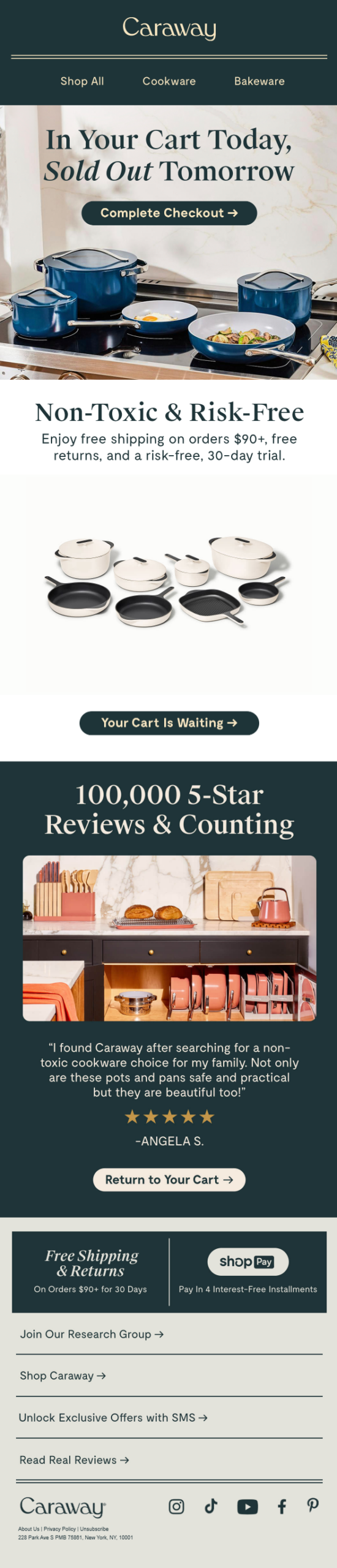
Caraway's emails are well-designed and follow a consistent brand voice. The problem is not the creative. It's a deliverability flag and a flow architecture that puts too many messages in front of the same buyer at once.

The spam score is a fixable infrastructure problem
At Caraway's sending volume, a spam score of 3.0 means a real portion of every send lands in junk. The creative is not the problem. Authentication setup, suppression hygiene, and list health are. None of that requires touching a single email design.
Subject Line Patterns
Most common words: sunshine, kitchen, Collection, Clean, New. Campaign examples:
SMS is reserved for the moment intent is highest. That's a deliberate choice.
Most brands fire SMS at anyone who adds to cart. Caraway waits. The system is gated to a specific action, and that one decision protects the entire channel.
Two cart SMS reminders, 27 minutes apart
Both link directly back to the cart. Clean, direct, no brand noise in the recovery window. They get two shots at the close in the first hour.
SMS shifts from recovery to brand channel
After the first 24 hours, the SMS channel stops chasing the cart. It moves to Sunday prep tips, product education, and brand content. This is a conservative approach, but it is intentional. They are not willing to train subscribers to ignore recovery texts by sending them every day.
The "Continue to Shipping" gate
Landing on the checkout page does not trigger SMS. Entering your email does not trigger SMS. The system waits for one specific action: clicking "Continue to Shipping." That one click is the signal that the buyer is not window shopping. When it fires, the SMS arrives in under 30 minutes and links directly to the shipping step, not back to the cart. Friction removed at the exact right moment.
Every SMS you send has a fatigue cost. Caraway accounts for that.
When you blast SMS at anyone who touches the checkout page, you train your list to ignore it. By gating recovery SMS to the "Continue to Shipping" click, Caraway ensures their highest-converting channel is only used when the probability of a sale is at its peak. It protects channel equity while making sure the revenue they do recover comes with minimum noise and maximum efficiency.

The Traffic Jam Problem
Caraway's flows have a structural issue: too many sequences running in parallel with no suppression between them. Each flow works in isolation. Together, they create noise at the exact moment a buyer needs a clear signal to commit.
Welcome Series
Solid execution. CEO note, brand story, flagship product focus. No loud discount in email 1, which is the right call for a premium brand at this price point.
Browse Abandonment
Fires after product page views with no cart action. For new subscribers, this runs at the same time as the welcome series. Two active flows, no suppression logic between them.
Abandoned Cart Flow
3-touch sequence. The SMS fires within 30 minutes and links directly to the shipping step. That's a smart gate. The gap is that there's no suppression stopping the cart flow and the welcome series from running at the same time.
Promotional Campaigns
Disciplined sends around seasonal moments and new collection launches. Visually consistent. The "Save $230" anchor on the flagship set gives buyers a clear reason to act.
Sunset / Win-back
Suppression appears under-configured. A spam score of 3.0 often reflects disengaged contacts being kept on active lists. The fix here is more aggressive suppression, not more sends.
Suppress competing flows when a buyer is in recovery mode
If a subscriber has an active cart, suppress all general nurture. One flow, one goal. Once the cart closes or expires, resume normal sequencing. Caraway already has the CDP infrastructure to do this. It is a configuration change, not a rebuild.
Caraway's campaigns are built to acquire. Lifecycle is built to expand.
We pulled Caraway's sends across December and January. The strategy is clear: they're running a disciplined acquisition engine with strong seasonal urgency. The long-tail opportunity is category progression.
 Holiday Push
 End of Year Deals
 New Year
Campaign volume gets the first sale. Lifecycle builds on what comes after.
Caraway cannot sell the same pan twice. Every campaign dollar goes toward acquiring a buyer who will only convert once on the flagship SKU. The bigger revenue lever is category progression: moving that buyer from a single pan to storage sets, bakeware, and the full kitchen suite. That is a lifecycle job, not a campaign job.
Five conversion gaps on the site
Caraway's site design is clean and on-brand. The gaps are mostly about what's missing at key decision points rather than anything broken.

Ad creative and landing page don't always match
Bottom-funnel ads feature specific colorways. But the destination is often a collection page instead of the product page for that colorway. Buyers land in the wrong place and have to work to find what they clicked on.
The "peek technique" is underused
The site doesn't use visual anchoring to encourage scrolling. Social proof and product detail live below the fold but nothing on-screen signals that to the user.
1-star reviews appear without context
Unfiltered reviews surface low-rated responses at the top for some SKUs. For a $445 product, that creates doubt right at the decision point. Caraway has 70,000+ positive reviews. The display logic isn't using that strength well.
No upgrade path on product pages
A buyer selecting the mini set has no prompt to consider the 5-piece or full bundle. For a non-replenishable product, the upgrade moment is at first purchase. There's no second chance at it.
The checkout trust bar disappears on mobile
Desktop checkout shows free shipping, free returns, and a customer count badge. On mobile, where most purchases happen, those trust signals are gone at the exact moment buyers are most likely to abandon.
Three paid search problems leaking budget
These aren't creative problems. They're feed hygiene and landing page issues that can be fixed without rethinking the overall paid strategy.
Price mismatch: $865 in the ad, $670 on the page
One Shopping campaign shows a price that's $195 higher than what the landing page displays. The discrepancy comes from outdated schema markup in the page code. Google accepts it but buyers notice, and it creates immediate distrust before they even scroll.
A 2-star variant is showing in Shopping results
While the brand's overall review score is strong at 70,000+ reviews, a specific variant is pulling a 2-star score into Google Shopping. A competitor reseller is showing 9,000 5-star reviews for the same bundle. Caraway is losing click-through on their own product to a third party.
"Ceramic cookware" sends buyers to a seasonal collection page
One of the highest-volume non-branded searches in the category lands on a seasonal collection page with no clear value proposition and no social proof above the fold. A competitor with a tighter dedicated landing page will outconvert on this keyword.
How the email program measures up
Key metrics from Caraway's sending domain, benchmarked against DTC kitchenware and premium home goods brands at a similar scale.
| Metric | Caraway | DTC Average | Assessment |
|---|---|---|---|
| Spam Score | 3.0 | < 1.0 | At Risk |
| Subject Line Length | 30 chars | 28–40 chars | Optimal |
| Email File Size | 3,864 kB | < 1,500 kB | Too Heavy |
| Emoji Use in Subjects | 16.67% | 20–35% | Disciplined |
Caraway is doing a lot right. Here's where to go next.
Caraway has built a genuinely strong acquisition engine with premium creative, disciplined campaign strategy, and a well-configured SMS program. The next layer of revenue does not require a platform change or a strategic overhaul. It requires better orchestration of what's already there.
The campaign engine is elite
Campaigns like the "Save $230" New Year's push are among the best in the DTC cookware category. Disciplined messaging, strong visual consistency, and clear value anchors that drive first-time volume.
Parallel flows are a tax on every paid click
Every Messaging Traffic Jam is acquisition spend working against itself. When cart recovery and general nurture fire at the same time, they create hesitation rather than resolve it. On a $445 product, that hesitation costs more than it does anywhere else in the funnel.
Gate SMS to the highest-intent moment
Triggering the final SMS push at the "Continue to Shipping" click is already in the playbook. It ensures the highest-converting channel is saved for the most qualified buyer without exhausting the list.
Profit in this category lives in Category Progression
In a non-replenishable category, lifecycle's job is to move a customer from a single pan to the full kitchen suite over time. That's not a campaign job. It's a retention and sequencing job.
Good acquisition gets buyers in. Good lifecycle gets more from each one.
Caraway's paid acquisition is working. The Traffic Jam, the parallel flow overlap, and the mobile checkout trust gap are what sit between current performance and a higher revenue per customer. None of those require a rebuild. They require sequencing, suppression, and a clearer message at the right moment in the buying journey.
Want us to run this audit on your brand?
Chronos works with 500+ DTC brands and has generated over $400M in owned-channel revenue. We'll map your full lifecycle system and show you where the gaps are.
Book a free strategy sessionData sources: Email benchmark data (spam score, subject line length, email size, emoji usage) sourced from Panoramata. Revenue and traffic estimates from Particl and SimilarWeb respectively. CRO findings presented by Nico Muoio (Bottomless). Google Ads findings presented by Filippo Caroli (Echelonn). All data is directional and based on publicly observable brand signals. Chronos Agency is not affiliated with Caraway Home.