
DTC Brand Audits: What's Really Working
We subscribe to the brand, browse like a real buyer, abandon the cart, and push all the way through to checkout. Then we publish everything we find. No access required. No agency spin. Real findings from the outside.
What a DTC brand audit actually covers
We track what a real subscriber receives from sign-up through checkout abandonment, across email and SMS, over a 2.5-week window. Every finding is based on what directly fires in the inbox, not what the brand reports from its own dashboard.
A Chronos brand audit tracks the full owned-channel lifecycle of a DTC brand from the position of an outside observer. We sign up, we browse, we add to cart, we return, we push through to checkout, and we document every email, SMS, and marketing touchpoint that fires at each stage. The findings cover lead capture design, welcome flow, cart and checkout recovery, SMS activation, campaign segmentation, email deliverability benchmarks, on-site CRO, and Google Ads. Every finding is tied to direct observation, not inference. We never claim to know what happens after a purchase because we do not make one.
DTC brands, audited from the outside.
Each audit covers a different buying model and a different stage of brand maturity. The specific gaps differ. The structural patterns keep appearing regardless.
 Non-replenishable · High AOV
Caraway has built genuine world-class infrastructure across several channels. Their SMS setup, welcome flow, and on-site CRO are all strong. But two parallel systems, cart recovery and general nurture, run simultaneously with no suppression logic, creating a messaging traffic jam at exactly the moment a $445 sale is in the balance.
The Messaging Traffic Jam: cart recovery and nurture emails overlap with no suppression. One system tries to close the sale. The other pulls the buyer back into research mode.
 Replenishable · Gen Z
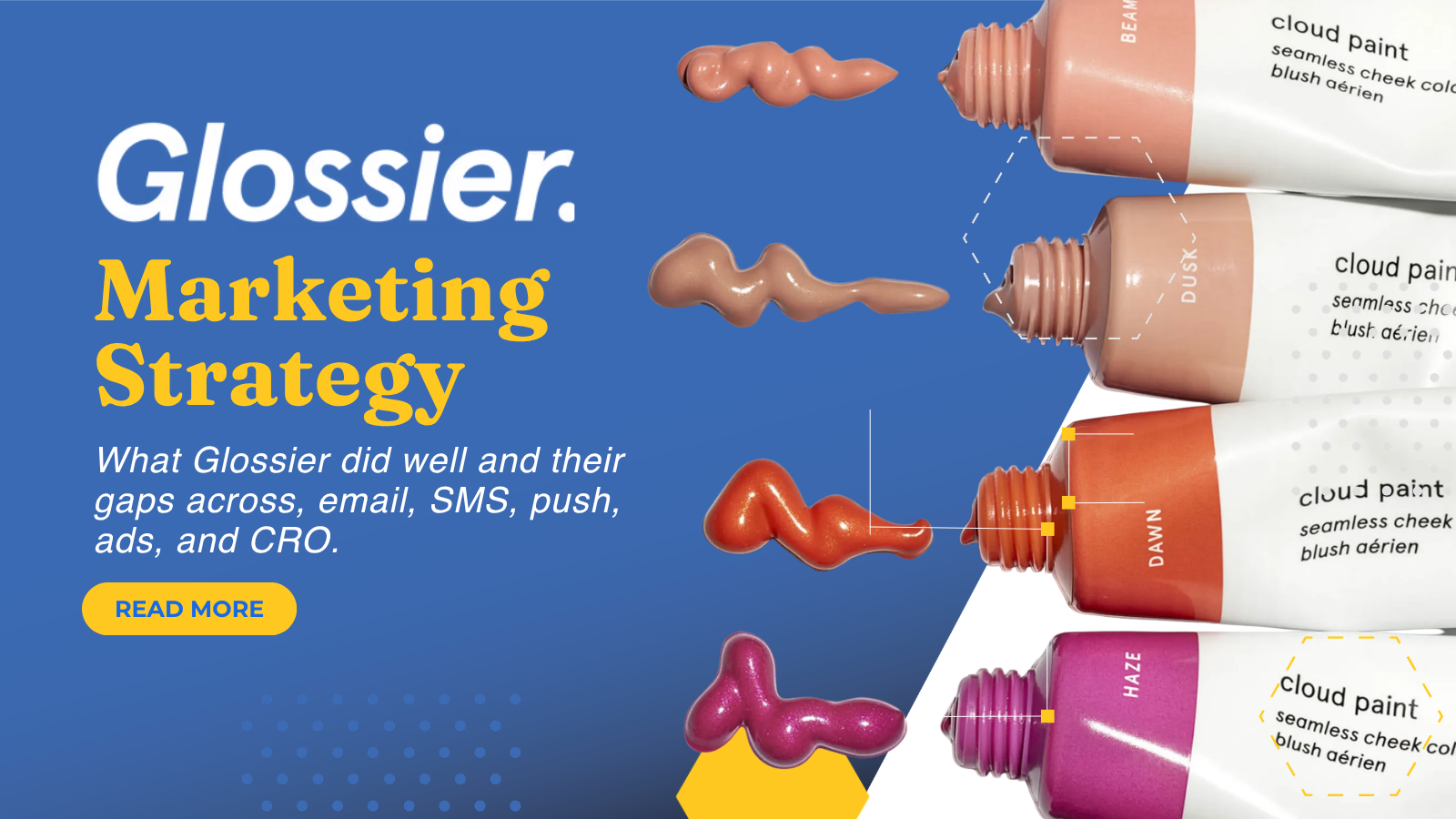
Glossier has built one of the strongest brand communities in DTC beauty, keychains, IRL events, member-only drops, a stay-or-goodbye sunset flow. The infrastructure is smart. The gap is that all of it runs through a Promotions tab, and the SMS channel that could reach the lock screen for every product drop and replenishment moment was inactive throughout the full audit window.
SMS Blackout: despite collecting phone consent via account creation, zero SMS messages were sent over 2.5 weeks including after cart and checkout abandonment.
 High-Consideration · Digital-Only
Allbirds closed every full-price U.S. store in January 2026 and went digital-only at $190M in annual revenue. The creative is sharp. The brand story is compelling. But 17 days of tracking, 10-plus emails, and not one message acknowledged the cart or the checkout abandonment. The recovery lane does not exist. And the SMS channel, despite explicit consent, was completely dark.
Missing Recovery Engine: no cart flow, no checkout flow, zero SMS activation, for a brand with no physical stores left and an LTV model that depends on shoe two, three, and four.
 Closet-Building · Founder-Led
Cassey Ho's activewear brand runs the best style quiz we have audited: twelve questions covering body shape, fit, coverage, color, and size, paying out $10 in FLEXdollars to complete. The website reads every answer and builds a personalized closet. The email program reads none of them. Our subscriber ruled out skorts, then received a six-product grid with three skorts in the first email that followed.
The Closet Behind Glass: world-class zero-party data collection that personalizes the website but never reaches the email platform, so every send is built on the store average.
Outside observer. Real subscriber. No special access.
Every finding in these audits comes from direct observation as a real customer going through the funnel. No platform access, no data exports, no interviews with the brand. Just what a subscriber actually receives.
Sign up as a real subscriber
We complete the full front-door experience, pop-up, welcome flow, account creation. We document what data is collected, what questions are asked, and what the first email actually says when it lands.
Stress-test the recovery system
We add to cart. We abandon. We return. We progress through checkout and stop at the final step. We watch what fires at each stage, with what timing, across both email and SMS.
Track everything over 2.5 weeks
We observe the full campaign engine across a 2.5-week window: what gets sent, how often, to what apparent segment, and whether any of it responds to the behavioral signals we have already sent.
Benchmark the email infrastructure
We measure deliverability signals: spam score, email file size, inbox placement, subject line length, emoji use, and send frequency. These signals predict whether emails actually reach the people they are sent to.
Audit the site as a buyer would
Where external CRO and Google Ads experts contribute findings, we include them with full attribution. CRO covers PDP trust architecture, objection handling, and mobile checkout friction. Google Ads covers Shopping feed quality and landing page congruency.
Publish with evidence, not assumptions
Every finding is supported by screenshots taken during the audit window. We do not speculate about what happens after purchase because we do not make one. We only write what we directly observed.
The same gaps keep appearing, regardless of brand size.
Different brands, different buying categories, different scale. The specific failures differ. These four structural patterns show up every time.
SMS collected, not activated
Most common gapEvery brand we audited collected SMS consent. None of them used it well. Glossier and Allbirds received zero SMS messages throughout the full audit window, including after cart abandonment and checkout progression. Caraway gated SMS correctly but let a QC error (SMS copy saying "cookware" linking to bakeware) go undetected at scale. POPFLEX sits one step further back: no phone field exists anywhere, so there is no list to activate. Collecting a phone number without activating the channel is not a win. It is a growing list of unconverted intent signals.
Recovery flows absent or broken
Highest revenue impactThe cart and checkout abandonment window is where the highest-intent buyers are. It is also where the lifecycle most consistently fails. Allbirds had no recovery flow at all, 17 days of observation, zero recovery emails, zero recovery SMS. Glossier sent two cart emails in 120 minutes with the same offer and nothing at checkout. Caraway's recovery flow existed but ran simultaneously with nurture emails, undermining both. POPFLEX built the lane and sized it backwards: five emails for the cart, two for the buyer at the payment screen. Recovery is not a nice-to-have at $100M in revenue. It is a structural requirement.
Pop-up captures, but never asks
Upstream root causeEvery brand collected an email address. None of them collected the zero-party data needed to personalize what comes next. Caraway buried their product quiz in the navigation. Allbirds asked nothing across six product lines. Glossier asked nothing despite having distinct skin types, routines, and concerns to segment by. When the front door collects no signal, every email that follows is a broadcast. The welcome flow, the browse abandon, the campaigns, all guessing. POPFLEX is the sharpest version of this pattern: it collects more signal than any brand we have audited, twelve questions of it, and the email program still guesses, because the answers never leave the website.
Lifecycle not updated when business changes
Signal of systemic debtAllbirds closed every U.S. store in January 2026. Their welcome email footer still says "Find a Store Near You." Their campaign footers across Valentine's, holiday, and summer all point to the same closed doors. This is not just a broken link, it is a signal that the lifecycle system has not been reviewed since a fundamental business decision changed everything about how customers need to be served. At every scale, outdated lifecycle content creates the same quiet trust erosion.
If your lifecycle program should be doing more, this is your benchmark.
Email and SMS should account for 30 to 40% of revenue for most DTC brands. These audits show what that infrastructure looks like when it works, and where it breaks at brands doing $100M to $200M in annual revenue.
Founders whose owned channels are not pulling their weight
Traffic is there. Revenue is there. But email and SMS are generating 10-15% when the program should be at 30-40%. These audits show where the LTV engine is leaking and what the structural fix looks like at brands doing serious volume.
Founders who want proof before they rebuild
If you are evaluating whether to overhaul your lifecycle program or bring in an agency, these audits show what a rigorous outside audit looks like, the methodology, the evidence standard, and the depth of finding you should expect.
Brand leaders responsible for retention and LTV
If you own the email and SMS program but lack visibility into what a real subscriber actually receives, these audits give you the outside observer view that internal dashboards and platform data cannot provide.
Common questions
Everything about how these audits work and who they are for.
Want us to run this audit on your brand?
Chronos works with 500+ DTC brands and has generated over $400M in owned-channel revenue. We will map your full lifecycle system and show you exactly where the gaps are.