
Glossier's Marketing Strategy, Broken Down
Glossier has built one of the strongest brand communities in DTC beauty. We tracked their full lifecycle system from pop-up to checkout abandonment to find where the momentum holds and where the revenue is quietly slipping out.
Watch the Full Audit Session
Josh Chin walks through Glossier's full email, SMS, CRO, and Google Ads setup live, with screen recordings, real data, and channel-by-channel analysis.
Low AOV and high repurchase frequency is a strong business model. It makes the lifecycle gaps more expensive, not less.
Before getting into the findings, it's worth framing what kind of brand we're auditing, because the stakes of each gap are different here than they are for a brand selling a $445 cookware set.
Glossier is a replenishable, low-consideration beauty brand. Boy Brow runs out. Balm Dotcom runs out. Milky Jelly Cleanser runs out. Buyers come back, or they don't, and a competitor gets the restock.
That replenishment cycle is the entire business model. A subscriber who buys every 60 days is worth ten times what a one-time buyer is. Which means the lifecycle job here is not to close a big, considered first purchase, it's to stay relevant, stay in the routine, and be the brand on the phone when the product runs out.
That's the lens for this audit. A $30 product with a 60-day replenishment cycle and a 2.2 million monthly visitor base does not get a pass on lifecycle gaps because the price point is low. The math goes the other way: at this volume and frequency, even a 5% improvement in recovery rate or inbox placement is worth millions.
Low AOV compounds fast in both directions
A subscriber who repurchases every 60 days generates 6 orders per year. At a $35 average order value, that is $210 in annual revenue per active customer, before basket expansion or referrals. At Glossier's traffic scale, the difference between a 30% and a 40% repurchase rate is not a rounding error. It is tens of millions of dollars.
Every SMS not sent during a replenishment window, every email buried in Promotions, every cart abandoned without a targeted recovery, these are not small inefficiencies. For a replenishable brand, they are recurring revenue walking out the door every single month.
A 5-second pop-up and a 15% discount. No questions asked.
Glossier's lead capture strategy is built on speed and impulse. The pop-up fires within 5 seconds, leads with a 15% discount, and asks nothing about skin type, routine, or product preference. For a $14 lip gloss, that logic makes sense. At $100M in annual GMV, the downstream cost of that choice is significant.
The bet they're making
Glossier has bet on impulse bias. They believe that for a low-AOV replenishable product, every second spent answering a question is a second the visitor might lose interest. The 15% discount bridges the gap to trial without friction.
The trade-off is personalization. Because no data is collected at entry, every subscriber gets the same follow-up regardless of what they came for, what their skin type is, or where they are in the buying journey.
At a smaller scale, the generic broadcast model works well enough. At $100M in online GMV, the gap between what they're sending and what each subscriber actually needs is a multi-million dollar drag on lifecycle revenue.
What we observed
✓ Fast capture at high volume
Firing within 5 seconds and leading with a clear offer is efficient at netting leads from 2.2 million monthly visitors. No friction before the email address.
✕ No qualification at sign-up
No skin type question, no routine question, no product interest signal collected. The subscriber enters the lifecycle as a blank profile. Every send after this is a broadcast, not a conversation.
✕ SMS is not collected at the front door
Glossier does not ask for a phone number during the pop-up flow. To give SMS consent, a subscriber must create a full account. Most subscribers will never do this, which means most of their list has no SMS channel open at all.


Beautiful emails that most subscribers never see.
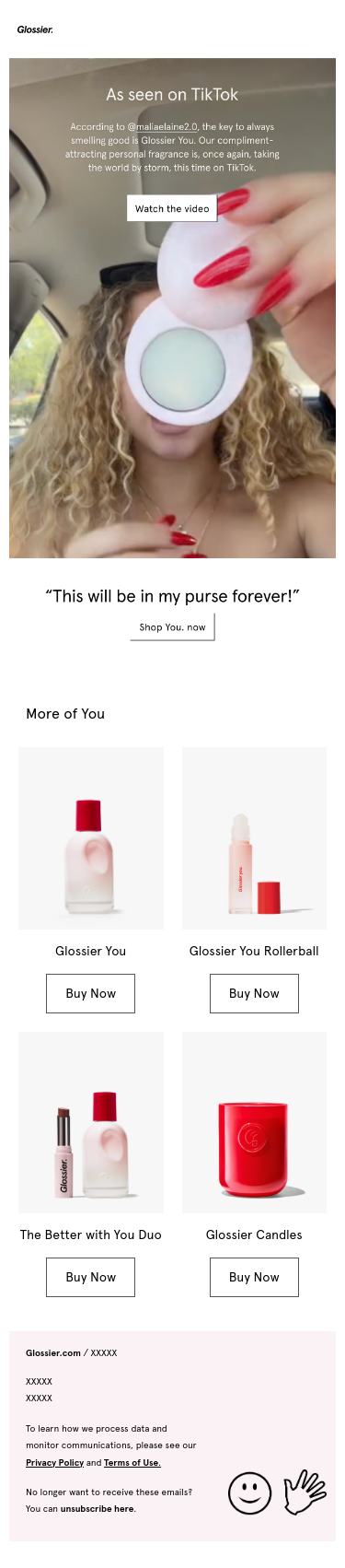
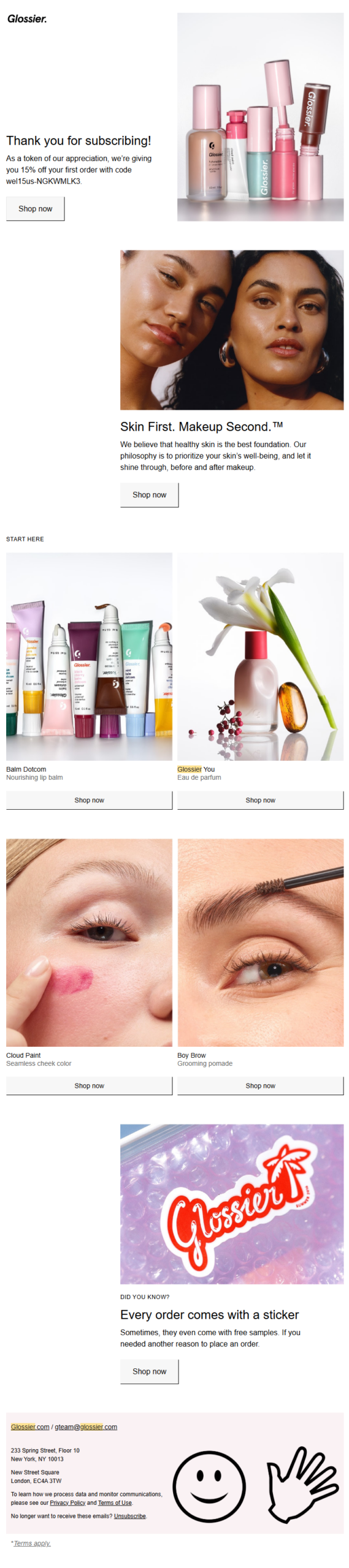
Glossier's emails are undeniably on-brand. Clean, minimal, high-white-space. The problem is a technical one: by building everything into static images with minimal live text, they're consistently landing in Gmail's Promotions tab rather than the Primary inbox.


Great creative that most of the list never sees
If 70% of a subscriber list never checks the Promotions tab, a brand is effectively paying to maintain a list where only 30% can be reached. For Glossier at their scale, fixing inbox placement is not a design decision. It is a revenue decision. Introducing live HTML text alongside imagery, reducing email file size, and improving sender authentication would move a meaningful portion of sends from Promotions to Primary.
Cart abandonment: fast but repetitive
We tracked Glossier's cart abandonment recovery after adding the Dewy Look bundle and returning to checkout before abandoning at the final shipping step. What we found was a fast but blunt recovery sequence.
First cart reminder fires quickly
Within 30 to 40 minutes of the cart add, the first recovery email arrives. Speed is good for high-intent recoverables. The send is timely.
Second email under an hour later, same offer
Less than 60 minutes after the first, a second email arrives with the exact same 15% discount. Two emails in 120 minutes with identical offers does not increase urgency. It trains the subscriber to wait for something different that never comes.
No upgrade in recovery even at the highest intent signal
We progressed all the way to the final shipping step before abandoning, a significantly higher signal of intent than a casual cart add. The recovery sequence treated us the same as a casual browser. No targeted checkout nudge, no SMS, no shipping-friction fix. The system did not recognise the difference.
Better cart recovery without sending more
Replace the second email with a personalized SMS for subscribers who have given their number. SMS has a significantly higher click-through rate for high-intent cart abandoners than a duplicate email sent in the same window. Show the full look in cart recovery rather than just the single item, increasing basket size makes the 15% feel like a better deal. At the 24-hour mark, test a shipping-cost removal nudge rather than a repeat discount. Shipping cost is the primary abandonment driver in beauty at lower basket sizes.
SMS consent collected. Nothing sent.
To give Glossier an SMS number, we had to create a full account and explicitly opt in to SMS marketing. Despite completing every step, we received zero SMS messages throughout the entire audit window, including after returning to the site days later as a high-intent signal.
We went through every step to receive an SMS. They never sent one.
Here is what we did to give Glossier every opportunity to reach us via SMS, and what happened at each step.
A Gen Z brand that has gone dark on the Gen Z channel
Glossier's core audience lives on their phones. SMS is where replenishable beauty brands have their highest-converting recovery moments. By staying off the lock screen, Glossier is shouting in a crowded Promotions tab while their most engaged channel sits empty. Every competitor who does send SMS during the replenishment window has the opportunity to intercept a sale Glossier already earned.
What SMS recovery looks like at a smaller scale
We ran a test for a medium-sized beauty brand in a comparable position: a large email list, minimal SMS penetration, and no SMS recovery sequences. By deploying an SMS-only pop-up targeted specifically at existing email subscribers who had not given a phone number, that brand generated over $26,000 in incremental revenue in two weeks.
Glossier has over 2 million monthly visitors and an estimated $100M in annual online GMV. The scale of the untapped SMS opportunity is proportionally significant.
Glossier's community play is genuinely strong. The delivery infrastructure isn't keeping up.
Glossier does not just want to sell a cleanser. They want to recruit you into a lifestyle. The membership system is smart, layered, and designed to create long-term loyalty. The problem is that it all runs through an inbox most subscribers never check.
What the membership system includes
Membership keychain as community badge
A physical keychain anchors digital membership with a real-world object. This is a smart ritual play that makes the brand feel tangible rather than transactional.
Early access to product launches
Members get first access to limited-edition drops and new product releases. This creates genuine urgency and rewards loyalty with something competitors cannot easily replicate.
In-person events for the community
Pop-ups, influencer parties, and community events turn customers into brand evangelists. Glossier invests in physical presence that most DTC brands skip entirely.
Stay-or-goodbye sunset flow
Inactive members are asked to choose their status, stay or go, with a reminder of member benefits. This protects deliverability and re-engages with something other than a generic discount.

The gap between community and conversion
The membership system is built for high-velocity community moments: event invites, early access drops, exclusive announcements. These are exactly the messages that need to reach the lock screen.
Instead, they go to the Promotions tab. When a subscriber officially becomes a member, gives their phone number, and then receives zero SMS, the brand's most engaged channel is sitting unused at the exact moments where urgency matters most.
Event invites in the Promotions tab
Even after becoming a full member and giving SMS consent, we received no SMS about community events, product drops, or early access. For a brand that relies on hype and velocity, failing to use the lock screen for these moments is a multi-million dollar gap. They've built the cult. The infrastructure isn't delivering it.


Hype and habit. The same products sent to everyone.
Glossier's campaign engine is built on two levers: limited-edition drops that create "now or never" urgency, and gift-with-purchase offers that drive AOV without discounting. Both levers work. The gap is that the same emails go to every subscriber regardless of skin type, purchase history, or where they are in their routine.
Social Proof
 Social Proof
 Seasonal Drop
In beauty, relevance is retention. Glossier is sending the same routine to everyone.
Sending "The Dewy Look" to a subscriber with oily skin is not just unhelpful, it trains them to ignore Glossier's emails. The zero-party data that would fix this could be collected at the front door with a single skin type question. Without it, Glossier is leaving personalization, restock timing, and routine-building revenue on the table at every send.
Strong personalization tools. Inconsistent execution getting buyers to them.
Glossier has invested in genuinely useful on-site personalization features. The gap is upstream: buyers are not always landing on the right page to discover them.

✓ Custom skincare kit builder is best in class
Glossier's guided kit builder walks buyers through a multi-step product recommendation flow: cleanser, treat, moisturise, skincare, add-ons. Mobile-optimised, with ingredient popups for each product. This is exactly the kind of guided buying experience that increases first-basket size and reduces returns.
✓ Skin-type filters on collection pages
Unlike generic filters on most beauty sites, Glossier's filters are genuinely useful: oily, dry, combination, sensitive. A buyer can find relevant products without reading every PDP. This is a retention feature as much as a discovery feature.
✓ Product diversity shown across PDPs
Lip product pages show the range across multiple skin tones and complexions. This is correct for a beauty brand, it removes a major barrier to trial for buyers who cannot visualise how a product will look on them.
Bottom-funnel ads do not always land on the product page
A Milky Jelly Cleanser ad sends buyers to a collection overview rather than the specific PDP. The congruency that makes bottom-funnel ads work, same product, same message, same visual, breaks at the landing page. Some product ads do get this right, including the perfume duo and Cookie Bomb, but it is not consistent.
"100% agree" claims trigger skepticism rather than trust
Perfect percentages read as manufactured. Real clinical study results, 98%, 94%, 78%, feel more honest because they show the methodology has room for variation. A claim that 100% of people agree with anything is more likely to make a buyer pause than convert.
UGC reads as staged rather than real
Glossier's user-generated content has good lighting, deliberate framing, and professional-looking shots. That is counterproductive for UGC, where the value is authenticity. Raw phone camera shots taken in actual bathrooms and bedrooms perform better at the conversion point because they look like what a real buyer would take.
Collection page "Add to Bag" bypasses the PDP
Buyers who click "Add to Bag" directly from a collection page skip the PDP entirely. For a buyer with a skin condition, allergy, or specific ingredient concern, this removes the information they need to buy with confidence. The skipped PDP also means skipping social proof, reviews, and the routine-building suggestions that increase basket size.
Strong search presence. Shopping feed needs work.
Glossier's Google Ads setup shows real sophistication in search and campaign structure. The Shopping feed has specific, fixable gaps that are quietly suppressing click-through on their own products.
What they get right
✓ Brand search is well-protected
Branded and non-branded campaigns are clearly separated in UTM tracking, which is the correct setup for measuring true customer acquisition cost. Long-tail branded keywords including specific product names are captured alongside the generic brand terms.
✓ Dedicated non-branded search landing pages
For queries like "nourishing lip balm," Glossier sends traffic to a dedicated landing page with brand story, value props, and ingredient information, designed for a new customer who has never heard of Glossier. This is the correct distinction from a PDP, which assumes some brand familiarity.
Where the gaps are
Shopping titles contain no prospecting keywords
A Shopping listing for Balm Dotcom shows "Balm.com" and a flavor name, the only keyword is essentially "balm." For a buyer who has never heard of Glossier searching for "tinted lip balm SPF" or "hydrating lip treatment," this product is effectively invisible.
Glossier's own imagery is not being used in Shopping
Shopping ads show plain product shots while Glossier's editorial and lifestyle imagery is used everywhere else. Their creative is a genuine competitive asset. Keeping it out of Shopping ads is leaving one of their strongest conversion levers unused in a channel where creative differentiation is rare.
How Glossier compares
Key lifecycle and brand metrics benchmarked against replenishable DTC beauty brands at a comparable scale.
| Metric | Glossier | DTC Beauty Average | Assessment |
|---|---|---|---|
| Annual Online GMV | ~$100M | $10M–$40M | Well above average |
| Monthly Visits | 2.2M | 200K–800K | High traffic scale |
| Inbox Placement | Promotions Tab | Primary / Promotions | At risk |
| SMS Recovery Active | Not observed | Standard practice | Critical gap |
| Entry Qualification | None | Basic segmentation | Missed opportunity |
| GWP Strategy | Active | Discount-led | Premium positioning |
| Community Infrastructure | Strong | Minimal | Differentiator |
Common questions about Glossier's marketing
What email platform does Glossier use?
Based on our audit, Glossier sends image-heavy HTML emails consistent with a major ESP. Their emails consistently land in Gmail's Promotions tab due to a high image-to-text ratio and use of static image blocks rather than live text. No SMS recovery was observed during the audit window despite explicit consent being given via account creation.
How does Glossier handle cart abandonment?
Glossier sends two cart abandonment emails within 120 minutes of a cart add, the first within 30 to 40 minutes, and the second less than an hour later carrying the same 15% discount from the welcome flow. No SMS was sent at any point in the cart or checkout recovery window, despite the audit account having given explicit SMS marketing consent via full account creation.
What is Glossier's marketing strategy?
Glossier's marketing strategy is built around brand gravity and community. They use limited-edition product drops, gift-with-purchase offers, and IRL events to drive purchase frequency and loyalty. Their email program is lifestyle-first and image-heavy, prioritising brand feel over inbox placement. The core gap in the lifecycle is SMS: despite having one of the most engaged Gen Z audiences in beauty, the SMS channel was effectively inactive during our full audit window.
Why do Glossier emails land in the Promotions tab?
Glossier's emails are built entirely from static images with minimal live text. Gmail's algorithm treats image-heavy emails with little readable text as promotional content and routes them to the Promotions tab. For a brand with millions of subscribers, this means a large portion of the list never sees the email at all. The fix involves introducing live HTML text alongside imagery and reducing total email file size.
Glossier has built something rare. The infrastructure hasn't caught up.
Brand gravity, community equity, and a genuinely engaged Gen Z audience are things most DTC brands spend years trying to manufacture. Glossier has them. The revenue gaps we found are not brand problems. They are infrastructure and orchestration problems, fixable without touching what makes Glossier distinctive.
Beautiful emails most of the list never sees
Image-heavy static emails consistently land in the Promotions tab. As ad costs rise, Glossier cannot keep acquiring new traffic to compensate for a list that only 30% of subscribers actively check.
A Gen Z brand silent on the Gen Z channel
Despite collecting SMS consent via account creation, the SMS channel was inactive throughout the entire audit window. Every replenishment window that passes without an SMS is an opportunity for a competitor to capture a sale Glossier already earned.
Sending the same routine to everyone
In beauty, relevance is retention. Glossier is sending the same hero products to every subscriber regardless of skin type or purchase history. One skin-type question at sign-up changes the economics of every send that follows.
Time-based recovery for all intent levels
The system treats a casual cart add and a final-shipping-step abandonment identically. A buyer who reaches the shipping step has already committed mentally. That moment needs a different message, not the same one sent 30 minutes earlier.
Glossier has a subscription product. They are not using SMS to sell it.
The Top Shelf Subscription offers 15% off a first order and 10% on every replenishment after. For a brand built on replenishable products, this is a powerful retention mechanic. It also never appeared in any SMS during the audit window. A subscription nudge sent at the right replenishment moment via SMS would close the restock sale before a competitor does.

The brand equity is there. The lifecycle system needs to match it.
Glossier has already done the hardest work: building a community that wants to hear from them. The deliverability issues, SMS gap, and personalization gap are all revenue efficiency problems that sit on top of a genuinely strong brand foundation. Fixing them does not require changing what Glossier is. It requires building an owned-channel infrastructure that delivers the brand they've already built to the subscribers who are already waiting to hear from it.
Want us to run this audit on your brand?
Chronos works with 500+ DTC brands and has generated over $400M in owned-channel revenue. We will map your full lifecycle system and show you where the gaps are.
Book a free strategy sessionData sources: Revenue and traffic estimates from Particl and SimilarWeb respectively. CRO findings presented by Nico Muoio (Bottomless). Google Ads findings presented by Filippo Caroli (Echelonn). All lifecycle, email, and SMS findings are based on direct observation during the audit window. All data is directional and based on publicly observable brand signals. Chronos Agency is not affiliated with Glossier.