
In the high-stakes environment of Q4 2026, the impulse for most DTC brands is simple: send more. But for brands in the $15–50M ARR range, this “batch-and-blast” reflex is a silent revenue killer.
Every extra email sent without a strategic “why” behind it accelerates holiday fatigue, leading to a visible spike in unsubscribes, SMS opt-outs, and a “deliverability hangover” that can paralyze your revenue through Q1.
At Chronos, our data from managing over 500 brands shows that while volume is a lever, it is rarely the differentiator. During peak BFCM windows, some brands successfully send hundreds of campaign emails, while others see their engagement crater after the third send.
The difference? Orchestration. You didn’t just collect orders during the holiday rush; you collected behavior. If you keep blasting your whole list with the same frequency, December will underperform.
As a Klaviyo Master Elite partner, Chronos views frequency not as a calendar decision, but as a retention architecture decision. To win in 2026, your holiday messaging must be:
- Segment-specific: Matching cadence to customer value.
- Lifecycle-aware: Treating “trial users” differently than loyalists.
- Deliverability-protected: Ensuring your January sends actually hit the inbox.
What Holiday Fatigue Actually Looks Like (And Why It’s Expensive)
Holiday fatigue isn’t just a decrease in open rates; it is a measurable decay in the health of your customer relationship. When you over-message without precision, you aren’t just “staying top of mind”—you are actively eroding your future revenue.
Engagement Compression During Peak Windows
During the high-pressure BFCM weekend, some brands successfully scale to an intense cadence.
For example, Chronos has seen brands like Olivia Jewelry reach 95% of their audience during peak months , achieving a 10x YOY increase in SMS revenue by sending as many as three emails per day.
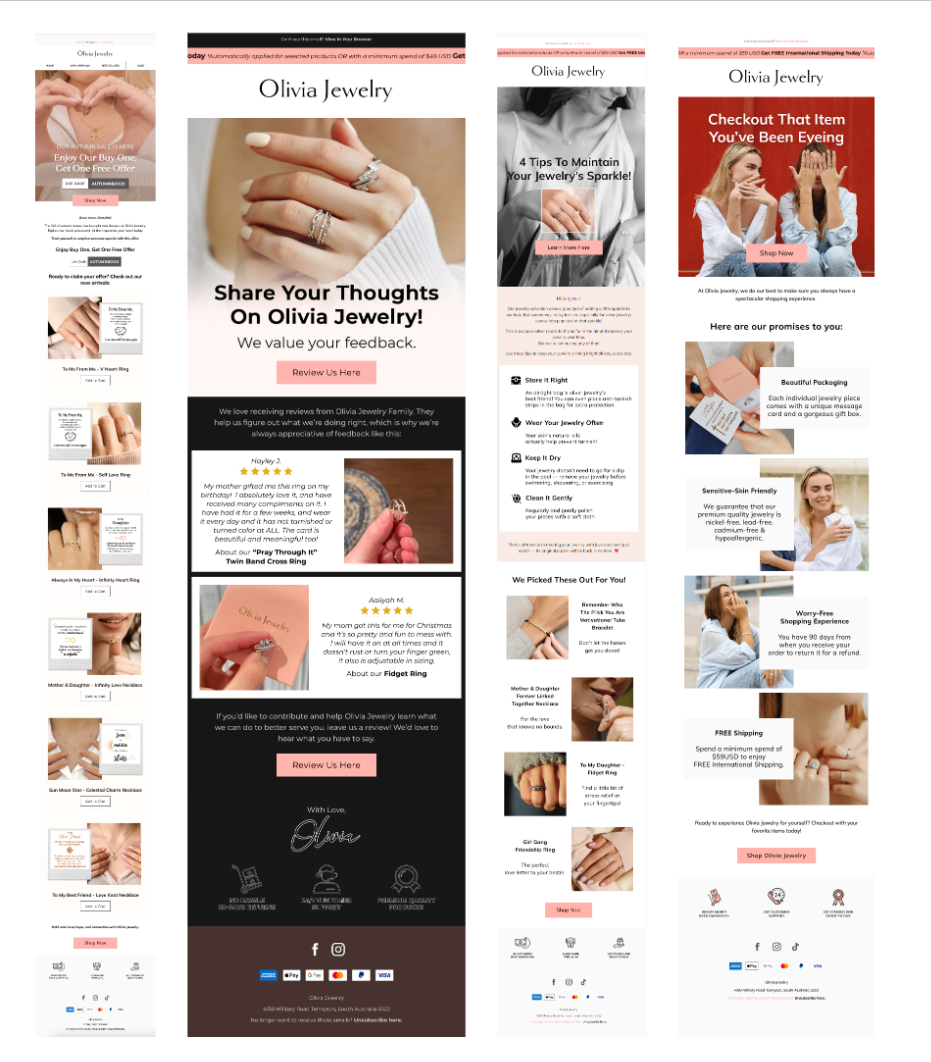
This high frequency succeeds only when it is backed by extreme segmentation and layered offers.
Truly Beauty utilized a similar high-volume strategy, deploying 30 emails and 12 retargets to capture 19% of total store revenue in just six days.
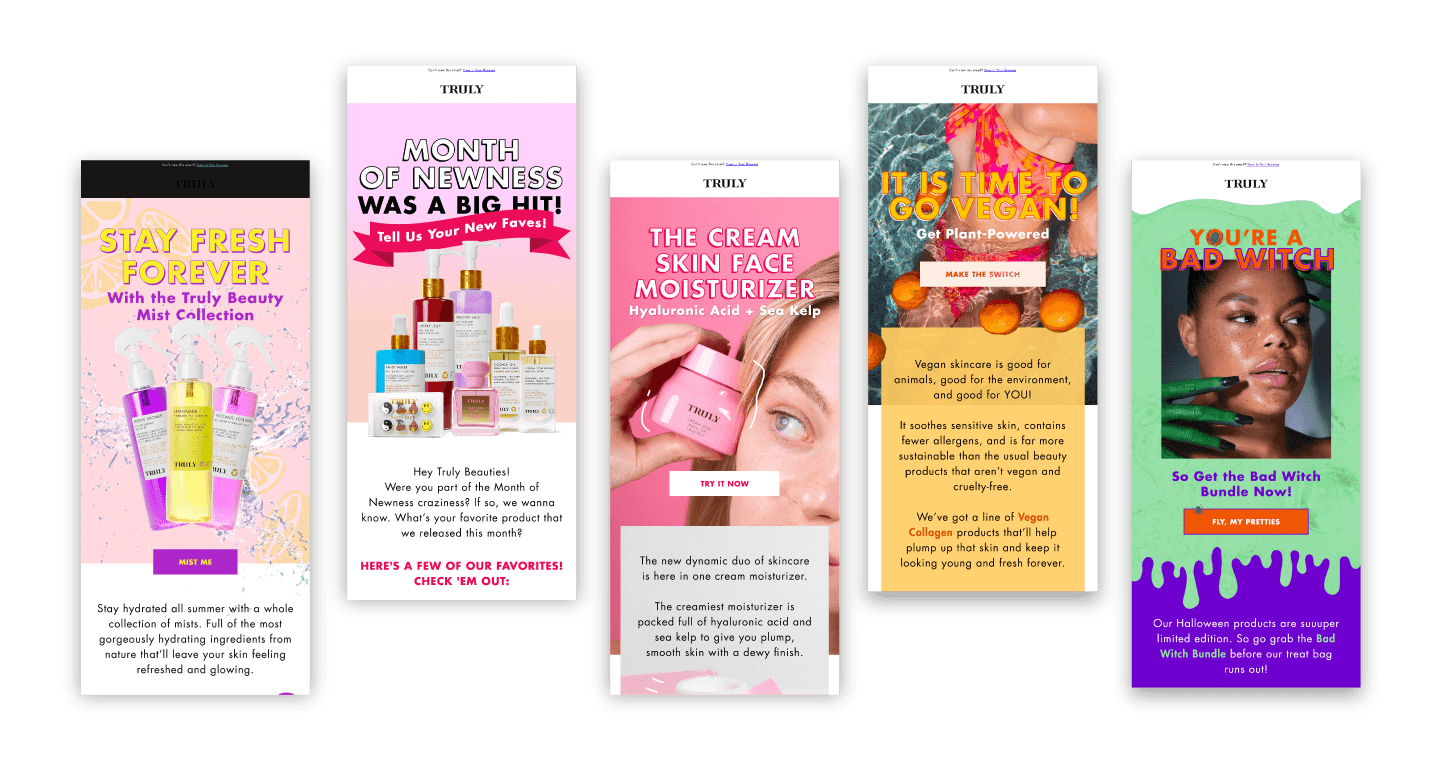
However, fatigue occurs the moment you shift from targeted sends to “blasting” your whole list. Without segmentation as a revenue safeguard, your December performance will suffer as subscribers tune out the noise.
Check out our December revenue capture plan and prep ahead to ensure you squeeze the most out of your owned channels.
Deliverability Decay That Surfaces in Q1
The true cost of holiday fatigue often doesn’t appear on a dashboard until January. Poor engagement hygiene during Q4 makes your resend strategies ineffective.
In engagement-recovery cases like Stopwatt and Pet Supplies Empire, Chronos found that tightening engagement-based targeting and suppressing low-intent contacts was the key to making resends viable again.
If you ignore suppression logic during the holidays, you aren’t just “missing a few opens”—you are signaling to ISPs like Gmail that your content is unwanted, which leads to deliverability suppression and revenue softness in the new year.
Check out the full guide on how to fix your deliverability here.
Margin Erosion Through Overexposure
Over-messaging leads to a “race to the bottom” where brands feel forced to increase discount depth mid-sale just to maintain attention. Frequent, unsegmented promos train your customers to wait for the next price drop, which accelerates price sensitivity and erodes your margins.
Elite retention teams avoid this by using tiered or structured offers rather than blanket discounts. Qure, for instance, layers exclusive bundles and returning-customer boosters over their sitewide offers to increase AOV without needing deeper sitewide cuts.
If you hit new sign-ups with constant promos immediately, they are likely to “ghost” the brand. Instead, the goal is to use variety and behavioral data to make every message feel like a new opportunity rather than a repetitive demand for a sale.
Holiday Email Frequency in 2026 — What Actually Works
Determining the ideal holiday email frequency is a balancing act between maximizing visibility and protecting your list from burnout. In 2026, the brands that outperform their peers are those that stop guessing at “send volume” and start architecting their cadence around customer behavior.
There Is No Universal “Safe” Number
Chronos’ extensive case study data proves that frequency tolerance is highly brand-dependent. Some high-growth brands see massive success with aggressive schedules:
- Truly Beauty successfully sent 30 campaign emails plus 12 retargets during a peak 6-day window.
- This high-intensity approach captured 19% of total store revenue in less than a week.
- Conversely, other brands prioritize system-led retention over raw volume. Fenix Store scaled their owned-channel revenue from 23% to 71% by focusing on structured, longitudinal planning rather than just increasing the number of monthly “blasts”.
Segment-Based Frequency Scaling Framework
Instead of applying a single daily cadence to your entire list, elite brands use segmentation as a revenue safeguard. This allows you to increase frequency for high-intent buyers while protecting your deliverability with colder segments.
- Tier 1 — VIP / High LTV: These are your most valuable customers who expect early access and exclusive treatment. For Qure, these VIP emails accounted for 55% of their total email revenue.
Watch the full masterclass session on how this is done, here.
- Tier 2 — Engaged (30–60 days): These users require product variation and moderate daily sends. Truly Beauty managed a 600,000-subscriber audience by splitting them into 5 distinct email segments to maintain relevancy.
- Tier 3 — Cold / 90+ Days: This group requires reduced cadence and re-engagement positioning. Organifi effectively utilized list “sunsetting” and a full warm-up sequence to increase campaign openers by 8x without burning their reputation.
Flow-First > Campaign-First
Increasing campaign frequency is often less effective than optimizing the automated systems that work in the background. Chronos consistently sees that rebuilding lifecycle flows drives faster, more sustainable revenue impact than simply sending more manual emails.
- Windflower Florist doubled their email revenue specifically through flow and lifecycle improvements.
- Nuve generated $6,258 in just 37 days starting from zero email history by prioritizing lifecycle setup.
- The Profit Ladder: Beyond standard abandonment, brands should use the holiday window to optimize post-purchase stacking. This includes one-click add-ons, thank-you page upsells, and specific offers inside order confirmation emails.
As a Klaviyo Master Elite partner managing over $400M in owned-channel sales, Chronos rebuilds these flow systems before advising on any send-volume increases.
Email vs SMS During Holidays — How to Balance Without Burning Either
In 2026, the question is no longer whether you should use SMS, but how you orchestrate it alongside email to maximize profit without causing a mass exodus of subscribers.
SMS is a high-leverage tool—it generates 8-10x more clicks than email and boasts 95%+ open rates, often within seconds. However, because it is so personal, the margin for error is razor-thin.
SMS Can Tolerate Higher Urgency — But Lower Margin for Error
Because SMS lands directly on a user’s lockscreen, it can tolerate a higher level of urgency that might feel “spammy” in an inbox. During peak windows, Chronos has seen brands successfully lean into this channel:
- Olivia Jewelry achieved a 10x YOY increase in SMS revenue by strategically increasing their November cadence.
- Fenix Store saw SMS click-through rates (CTR) hit 56% during their holiday campaigns.
- The key is to reserve SMS for high-impact “Trigger Points” like shipping cut-off countdowns, back-in-stock alerts, and VIP access to gift sets.
Channel Affinity Should Guide Cadence
Cross-channel orchestration is what separates elite retention teams from reactive senders. Instead of blasting the same message on both channels simultaneously, use Channel Affinity to send via a customer’s preferred platform first.
- When channels are stacked correctly, it creates a “Halo Effect”.
- For example, a push notification or SMS can drive an 11% lift in CTR when cross-attributed with other channels.
- This prevents redundant messaging while ensuring your most important alerts—like “Your weekend cart is still saved”—are seen where the customer is most active.
Protect SMS Opt-In Value
SMS fatigue damages long-term retention faster than email fatigue because it is harder (and more expensive) to re-acquire an SMS opt-in once lost. To prevent burnout, your cadence must be layered strategically:
- During Truly Beauty’s multi-phase sale, they utilized 14 SMS plus 2 retargeting SMS to maintain a 75.8% list utilization rate.
- A critical tactic for protecting your list and your budget is to exclude recent email clickers from SMS sends.
- This single move can save 12-18% in send costs while ensuring you aren’t over-messaging your most active users on multiple fronts.
Chronos Positioning: As a Klaviyo Master Elite partner, we focus on this level of targeting discipline. It allows brands to scale revenue by 3x via lifecycle and SMS strategy without exhausting their subscribers.
How to Stand Out During Holidays Without Spamming
Standing out in a crowded 2026 inbox isn’t about being the loudest; it’s about being the most relevant. Brands that win avoid the “spam” label by shifting from static, repetitive broadcasts to dynamic, behavioral storytelling.
Daily Variation Prevents Fatigue
Fatigue is rarely caused by the frequency of emails; it’s caused by the monotony of the content. If you send the same hero image with a “Shop Now” button five days in a row, your engagement will crater.
- Rotate Your Creative: Use daily category-specific emails that highlight different parts of your catalog under the same umbrella offer.
- Shift Your Hooks: If a customer didn’t open your first “Sale Live” email, hit them with a fresh subject line and a new angle, like social proof or a founder’s note.
- Leverage Social Proof: Feature UGC (User-Generated Content) and customer reviews to break up promotional messaging and build trust.
Offer Structure > Discount Depth
Many brands panic and deepen their discounts when they don’t see immediate results, but this only trains customers to wait for the next “price drop”.
- Layer Your Offers: Use tiered spend thresholds (e.g., “Spend $120, get a free gift”) to protect your margins while encouraging higher AOV.
- Personalized “Boosters”: For brands like Qure, offering exclusive bundles or returning-customer “boosters” was more effective than a simple flat discount.
- Zero-Party Data: Use quizzes and forms to ask customers about their interests (e.g., skin concerns or preferred instruments) so you can tailor the products you show them.
Don’t Blast the Entire List Daily
The most effective way to prevent holiday fatigue is a simple rule of discipline: send daily, but do not send to everyone.
- Reserve Full-List Sends: Only blast your entire database for “high-stakes” moments like the initial sale launch or the final “Last Chance” hours.
- Focus on the Engaged: For the middle of the sale, limit your broadcasts to those who have opened, clicked, or visited the site in the last 7–10 days.
- Segment by Intent: Target “High-intent non-buyers”—those who viewed products or added to a cart but didn’t finish the transaction.
Use the Post-BFCM “Regret Window”
One of Chronos’ most effective strategies is the 48–72 hour post-BFCM window. This is when consumers rethink what they missed out on: “I should’ve grabbed that” or “Is it still in stock?”.
- Target Post-Peak Intent: Instead of more generic blasts, target cart abandoners and multi-session visitors with a “Last Chance” reminder.
- Close the Loop: Remind them of the exact items they were browsing with a soft complementary-product recommendation to close the loop on existing intent.
The 2026 Holiday Cadence Framework (Practical Answer)
To move beyond the “guesswork” of holiday messaging, your 2026 calendar requires a structured, phase-based approach. Frequency isn’t a static number; it’s a sliding scale that ramps up with consumer intent and ramps down to protect list health.
60–90 Days Pre-Holiday: The Foundation
- Clean the List: Conduct a full deliverability audit, including list sunsetting and engagement recovery.
- Warm Up Flows: Update all core automated triggers—Welcome, Abandoned Cart, and Browse Abandonment—to include seasonal creative.
- Build VIP Early Access: Use high-intent lead capture forms to build an exclusive list for early-access sales. Chronos saw Qure achieve a 17% lead capture rate by focusing on these early sign-ups.
14 Days Pre-Holiday: The Anticipation Phase
- Increase Cadence for Engaged: Start sending teaser campaigns to your most active segments to build anticipation.
- SMS Opt-In Push: Leverage your VIP list by offering “first-in-line” status for those who opt into SMS.
- Segment by Behavior: Identify different buckets like first-time buyers vs. repeat buyers to tailor your pre-sale messaging.
Peak Weekend (BFCM Example): The High-Intensity Phase
- Engaged Tiers: It is possible—and often profitable—to send 2–3 emails per day to your most engaged tiers. Chronos helped Olivia Jewelry achieve 10x YOY SMS revenue by maintaining high visibility during these peak hours.
- Channel Orchestration: Use SMS for time-sensitive alerts, such as “Last 4 hours” or shipping cut-offs.
- Resend Strategy: Automatically resend campaigns to non-openers with a fresh subject line and a new hook to maximize reach without duplicate effort.
Post-Holiday: The Retention Bridge
- The “Regret Window”: In the 48–72 hours after Cyber Monday, target cart abandoners and multi-session visitors who “missed out”.
- Convert First-Time Buyers: Pivot your messaging toward order education, UGC, and soft complementary-product recommendations to turn “trial users” into repeat customers within 30 days.
- Passive Sign-Up Warmth: Give new sign-ups 5–7 days of value (best-sellers, founder story) before hitting them with another hard promo to prevent them from “ghosting” the brand.
Conclusion: Frequency Is a Systems Decision — Not a Guess
In 2026, holiday fatigue won’t be caused by the volume of your sends; it will be caused by poor segmentation, weak automated flows, and redundant channel messaging. High-performing brands treat their calendar as a lifecycle engine, not a series of disconnected blasts.
Chronos’ internal data consistently shows that flow rebuilds can double revenue in a 30-day window and that engagement-tightening is what unlocks high-performance resends.
As a Klaviyo Master Elite partner, Chronos builds the architecture that allows you to scale volume intelligently while protecting the long-term LTV of your customer base.
Is your 2026 messaging plan built on a guess, or a system?
Book a Holiday Messaging Audit and let’s ensure your email and SMS cadence drives revenue—not fatigue.

