
Chronos Agency Guide
How to Build a Post-Purchase Email & SMS Flow That Drives Repeat Revenue
The architecture behind 500+ DTC brands at 8 to 9 figures. Real data. Real case studies. Built by Chronos Agency.
TL;DR
This guide breaks down the post-purchase flow architecture Chronos builds for 8 to 9 figure DTC brands. It covers flow structure, product intelligence, replenishment timing, SMS strategy, behavioral triggers, and how the post-purchase flow connects to the rest of the lifecycle system.
Every section includes real performance data from client accounts and actionable steps for your own flows. To get your current post-purchase setup audited against this architecture, book a free strategy call.
Table of Contents
 Why Post-Purchase Flows Are the Highest-ROI Automation Most Brands Underinvest In
 The Post-Purchase Flow Architecture That Actually Compounds
- Your Bestseller Might Be Killing Your Post-Purchase Flow
- Replenishment Timing: Why Fixed Windows Cost You Revenue
- Layering SMS Into Your Post-Purchase Flow as a Parallel Channel
- Behavioral Triggers That Lift Repeat Purchase Rate
- The Flow Ecosystem Your Post-Purchase Sequence Sits Inside
- Post-Purchase Email Sequence Timeline: What to Send on Which Day
- Frequently Asked Questions
Every customer acquisition has a cost behind it. By the time someone places an order and the package lands on their doorstep, the brand has already spent real money getting them there. The two weeks after that delivery are the cheapest window in the entire customer lifecycle to drive a second purchase. Intent is high. Trust is fresh. The customer already has the product in hand.
Watch the breakdown first, then dig into the full architecture below.
Josh Chin walks through the Day 82 post-purchase architecture, the Klaviyo trigger setup, the Smart Sending fix, and the three changes that move repeat purchase rate the fastest. 11 minutes.
Video Chapters
- 0:00 The post-purchase flow most brands run (and the one that runs to Day 82)
- 1:07 The 8-point self-audit
- 1:42 The 3 fixes that actually matter
- 1:52 Fix 1 — Two separate flows (first-time buyer vs. repeat buyer)
- 2:49 Klaviyo trigger setup walkthrough
- 3:20 The Smart Sending setting killing your flows
- 4:08 The Qure Skincare Day 82 architecture
- 4:24 Phase 1 — Confidence emails (Days 0-3)
- 5:29 Phase 2 — Behavioral branching by skin concern (Days 4-17)
- 6:36 Phase 3 — Lifecycle integration (Days 17-82)
- 7:07 Fix 2 — Replenishment timing (the Nuvé fix)
- 8:14 Pull your real average time between orders from Predictive Analytics
- 8:46 Fix 3 — Education emails that earn without discounting
- 9:55 Designed vs. plain-text email format testing
- 11:08 What to do this week (6-point action checklist)
The typical post-purchase flow ignores this window. A thank-you email, a review request, a 10% off coupon with a 48-hour expiry, then silence until the next campaign. At Chronos, we've rebuilt post-purchase flows across 500+ DTC brands at 8 to 9 figures, and the same gap shows up in almost every account we audit. The flow is too short. The cross-sell logic is generic. The whole sequence treats every customer the same regardless of what they bought.
The data point that captures the gap is this: Qure Skincare's returning customer base grew +76% year over year while the returning customer rate percentage was dropping. The business was compounding. The Shopify dashboard was telling the wrong story because the acquisition rate was outpacing the cadence at which repeat purchases could land.
The post-purchase flow is where these patterns either build or break. The Qure post-purchase sequence opens at 72.9% on the first email and holds between 66% and 72% through email four. That level of engagement comes from building the flow around product behavior and purchase data, not from dropping a five-email template into Klaviyo.
This guide covers how we build these flows.
Chapter 1
Why Post-Purchase Flows Are the Highest-ROI Automation Most Brands Underinvest In
The post-purchase window is the cheapest retention lever available because the customer has already paid and already trusts the brand. No ad spend, no discounting, just relevant communication to someone holding the product. The brands that build for this window see compounding repeat purchase outcomes.
The two weeks after a customer receives their order are the easiest window to drive a second purchase. They've already converted. They've already given you their money, their address, and their trust. Every email in this window is reaching someone who is actively forming an opinion about whether they'll buy again.
That makes post-purchase the lowest-cost retention lever available. No ad spend. No discounting to win attention. Just relevant communication to someone who already has the product in their hands.
Run the audit below against your current flow.
Self-Audit
Does your post-purchase flow have these problems?
If four or more apply, your post-purchase flow is costing you repeat revenue every day it runs.
The brands that fix this see compounding results across their entire lifecycle program.
Case Study
TheraICE: 153% increase in customer retention
A full lifecycle rebuild anchored by post-purchase architecture. The post-purchase sequence became the foundation for every downstream retention outcome.
Case Study
Textales: 3x retention-driven revenue
Repeat purchase logic across email and SMS. The post-purchase flow was the primary revenue driver in the first 60 days.
Case Study
Ecotraveller: email revenue share from 12% to 40% in under 60 days
Post-purchase flows rebuilt in week one. The rest of the system followed.
The first post-purchase email should be a confidence email. Its job is to make the customer feel like they made the right call. That's what earns the second purchase.
Chapter 2
The Post-Purchase Flow Architecture That Actually Compounds
A high-performing post-purchase flow is a branching system that adapts based on what the customer bought, how they're engaging, and where they are in their purchase cycle. The architecture has three phases (Confidence, Behavioral Branching, Lifecycle Integration) and runs to roughly Day 82 for products with meaningful repeat purchase potential.
Before walking through the architecture, there's one foundational decision most brands skip entirely.
For the strategy layer behind this entire approach, Josh's video below covers how email, SMS, and push connect into the central nervous system of an 8 to 9 figure DTC business.
Josh Chin on how to turn email, SMS, and push into the central nervous system of your business in 2026.
Your post-purchase flow should be two flows
A first-time buyer needs confidence and education. A repeat buyer needs recognition and catalog expansion. Running one flow for both audiences means the messaging misses for everyone in it.
First-Time Buyer Flow
✔️ Build confidence in the purchase
✔️ Product education and onboarding
✔️ First cross-sell at Day 17
✔️ Move toward second purchase
Repeat Buyer Flow
✔️ Recognize the returning customer
✔️ Expand catalog awareness
✔️ Move toward VIP threshold
✔️ Deepen the relationship
The Klaviyo trigger setup looks like this:
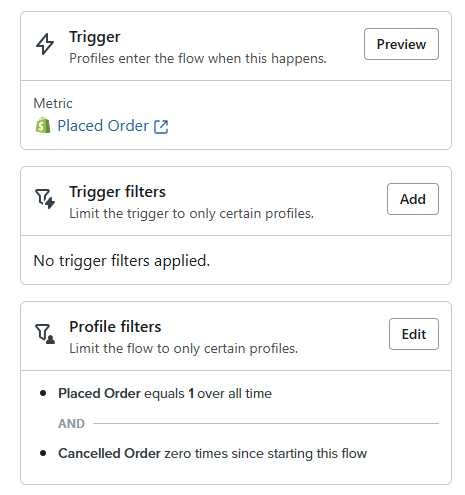
First-time buyer flow: triggers on first order only, filters out cancellations.
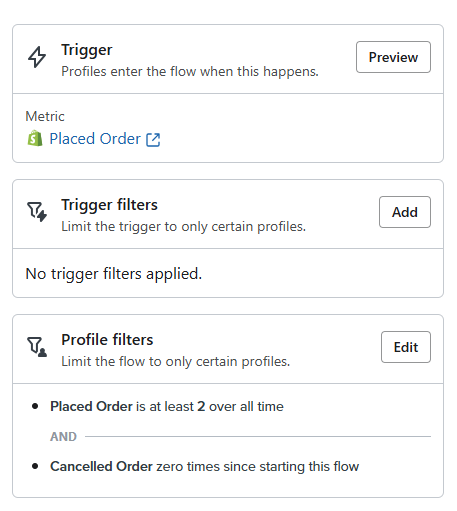
Repeat buyer flow: triggers on second order and beyond.
The cancellation filter matters more than it looks. Without it, reversed transactions still trigger the full sequence. A customer who cancels an order and then receives a "thank you for your purchase" email four hours later is a customer who has lost trust in your brand.
When should the first post-purchase email send?
If the first email is a branded order confirmation replacing Shopify's default, send it immediately. If it's a content or branding email like a founder story or product guide, delay it 30 minutes to an hour.
Shopify sends its own transactional confirmation the moment an order is placed. If the Klaviyo flow fires at the same time, two emails land in the inbox within minutes of each other. Double-stacking in the first hour trains the subscriber to ignore the brand entirely.
⚠️ Klaviyo Setting: Turn Smart Sending OFF for All Flows
Smart Sending prevents over-mailing by skipping emails when the subscriber has received another email recently. In campaigns, that behavior is useful. In flows, it silently suppresses carefully timed post-purchase emails.
If a campaign goes out at 10am, the Day 3 education email gets skipped. No bounce. No error. The email just doesn't send.
The fix: Turn Smart Sending OFF in every flow. Manage send frequency through segmentation and flow filters instead.
The architecture: how a high-performing post-purchase flow works
This walkthrough is based on the Qure Skincare account where the post-purchase flow opens at 72.9% on email one and holds between 66% and 72% through email four.
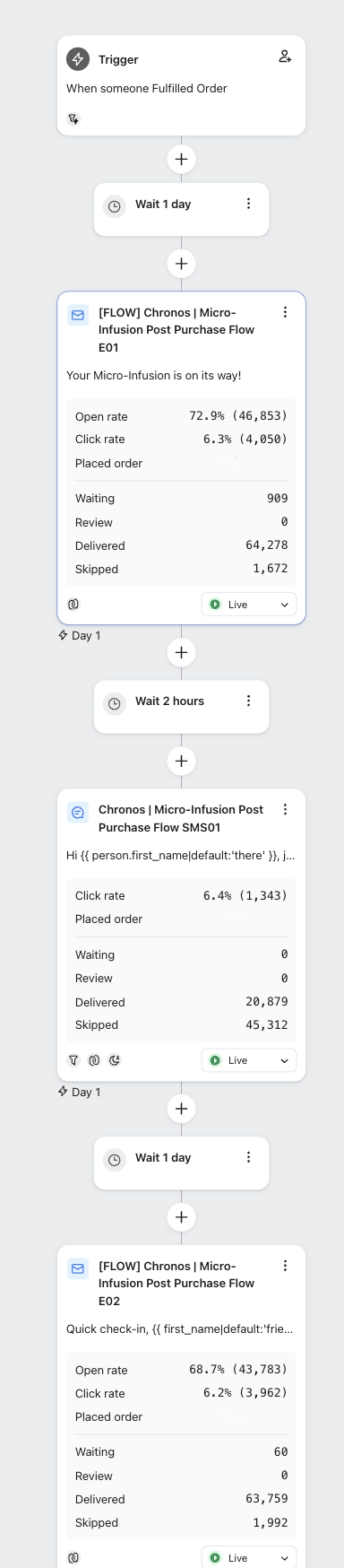
A Chronos post-purchase flow inside Klaviyo. Trigger through confidence emails, behavioral branching, and lifecycle integration running to Day 82.
Phase 1: Confidence (Days 0-3)
The first email opens at 72.9%, with SMS running in parallel two hours after the email sends. The email's only job is to reinforce the purchase decision. No sell. No ask.
The second email is educational. For Qure, that's a Micro-Infusion System Guide covering safety dos and don'ts, post-treatment care, and dermatologist validation. No discount. No review ask.
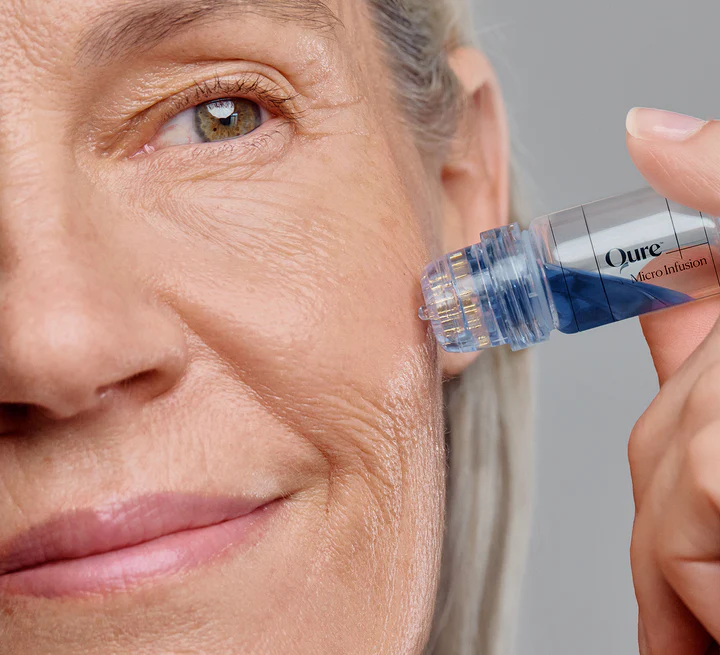
Qure's Micro-Infusion serum: a consumable product with natural repurchase gravity. The post-purchase flow is built around this product's usage cycle.
The third email has a single ask: add the treatment schedule to your phone calendar. No discount. No push. One action.
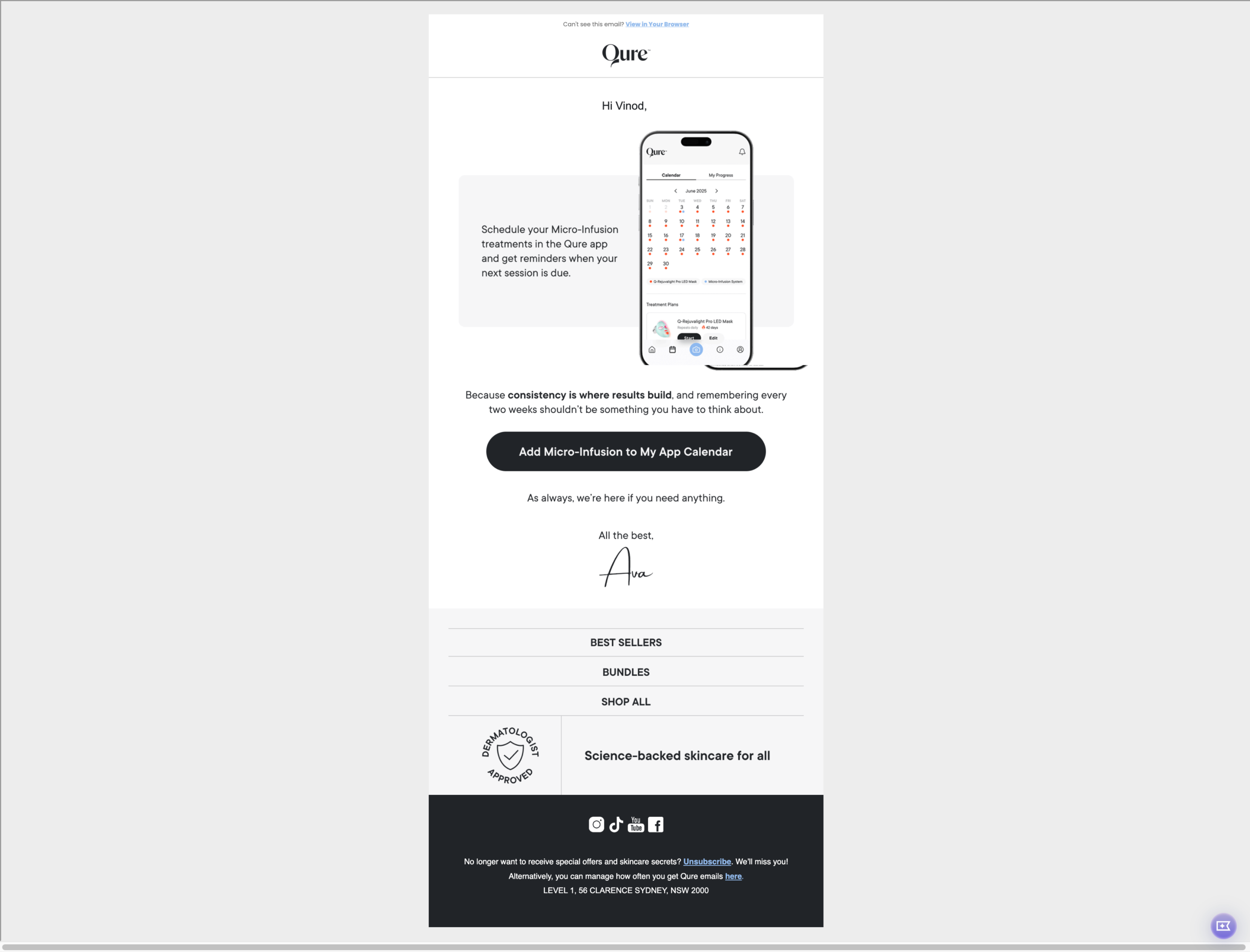
One email, one ask: add the treatment to your calendar. No discount. No review request. One action that builds the habit.
Phase 2: Behavioral Branching (Days 4-17)
Open rates hold between 66% and 72% through email four because the content adapts based on what the customer actually bought.
The flow branches by product interest. For Qure, that means a Fine Lines path and a Dark Spots path. A customer who bought a product targeting fine lines receives cross-sell recommendations relevant to that concern.
Non-openers hit a re-engagement branch with a different subject line. Customers who opened but didn't click receive an objection-addressing follow-up.
The first cross-sell fires at Day 17. That timing is deliberate. It waits until the customer has had enough product experience to form an opinion.
Phase 3: Lifecycle Integration (Days 17-82)
The flow doesn't stop at the cross-sell. It continues building the customer profile through the next two months.
A gender split at Day 65 improves catalog relevance for future sends. A survey at Day 82 captures zero-party data that feeds future segmentation. Retargeting sequences fire at each branch point for non-converters.
The flow runs to Day 82. Most brands stop at Day 7. The gap between those two numbers is where repeat purchase rate lives.
Post-Purchase Flow Architecture at a Glance
Phase 1
Confidence (Days 0-3)
Email 1
Purchase reinforcement. 72.9% open rate.
Email 2
Product education. No discount. No review ask.
SMS
Parallel send, 2 hours after email. Consented only.
Phase 2
Behavioral Branching (Days 4-17)
Path A
Product interest: Fine Lines
Relevant cross-sell
Open rates: 66-72%
Path B
Product interest: Dark Spots
Relevant cross-sell
Open rates: 66-72%
Non-openers: re-engagement branch. Opened, didn't click: objection-addressing follow-up.
Phase 3
Lifecycle Integration (Days 17-82)
Day 17
First cross-sell. Product-matched.
Day 65
Gender split. Catalog relevance.
Day 82
Zero-party data survey. Feeds future segmentation.
This flow runs to Day 82. Most brands stop at Day 7.
Context
Most accounts we onboard have a post-purchase flow with 2-3 emails, no behavioral branching, no first-time vs. repeat split, and a review request firing before the customer has received their order. The architecture above represents what a mature post-purchase system looks like after a full lifecycle rebuild.
Chapter 3
Your Bestseller Might Be Killing Your Post-Purchase Flow
The post-purchase flow is only as effective as the product it's cross-selling. Three questions reveal which products in your catalog actually build retention: does this product lead to a second purchase, is it a relationship starter or ender, and what does cohort data show for customers who bought it first.
Every product in your catalog creates a specific pattern after it reaches a customer's doorstep. Some products pull people back. Some products complete the need entirely. The post-purchase flow is only as effective as the product it's cross-selling.
Most guides on post-purchase flows tell you when to cross-sell. Very few address what to cross-sell and why the answer matters more than the timing.
Three questions that reveal which products actually build retention
1. Does this product lead to a second purchase, or does it complete the customer's need?
Some products have natural gravity. They're consumable, they require a refill, or they create a routine that pulls the customer back in. Other products are one-time purchases by design.
A skincare serum that runs out in 30 days behaves completely differently from an LED face mask that lasts for years. When you identify the products with gravity, retention planning becomes predictable.
2. Is this product a relationship starter or a relationship ender?
Look at your entry products. When someone starts with a specific item, what's the actual likelihood they ever return?
The Shopify dashboard shows which products sell the most. It does not show which products create customers who come back. We've seen hero products that drive massive upfront revenue but show ~5% repeat purchase rate at the cohort level. Meanwhile a smaller starter product can bring in customers who buy four or more times in 90 days.
3. What does the repeat purchase data say about customers who bought this product first?
This is where cohort analysis earns its keep. Break the returning customer rate down by first product purchased. Certain products almost always produce dramatically higher retention rates than others.
At Qure Skincare, the consumable serum cohort showed strong month-over-month retention. The LED mask cohort showed near-zero natural repeat purchase because nobody buys a second mask within a short window. The entire retention outcome for that cohort depended on the post-purchase flow's ability to cross-sell into the consumable range.
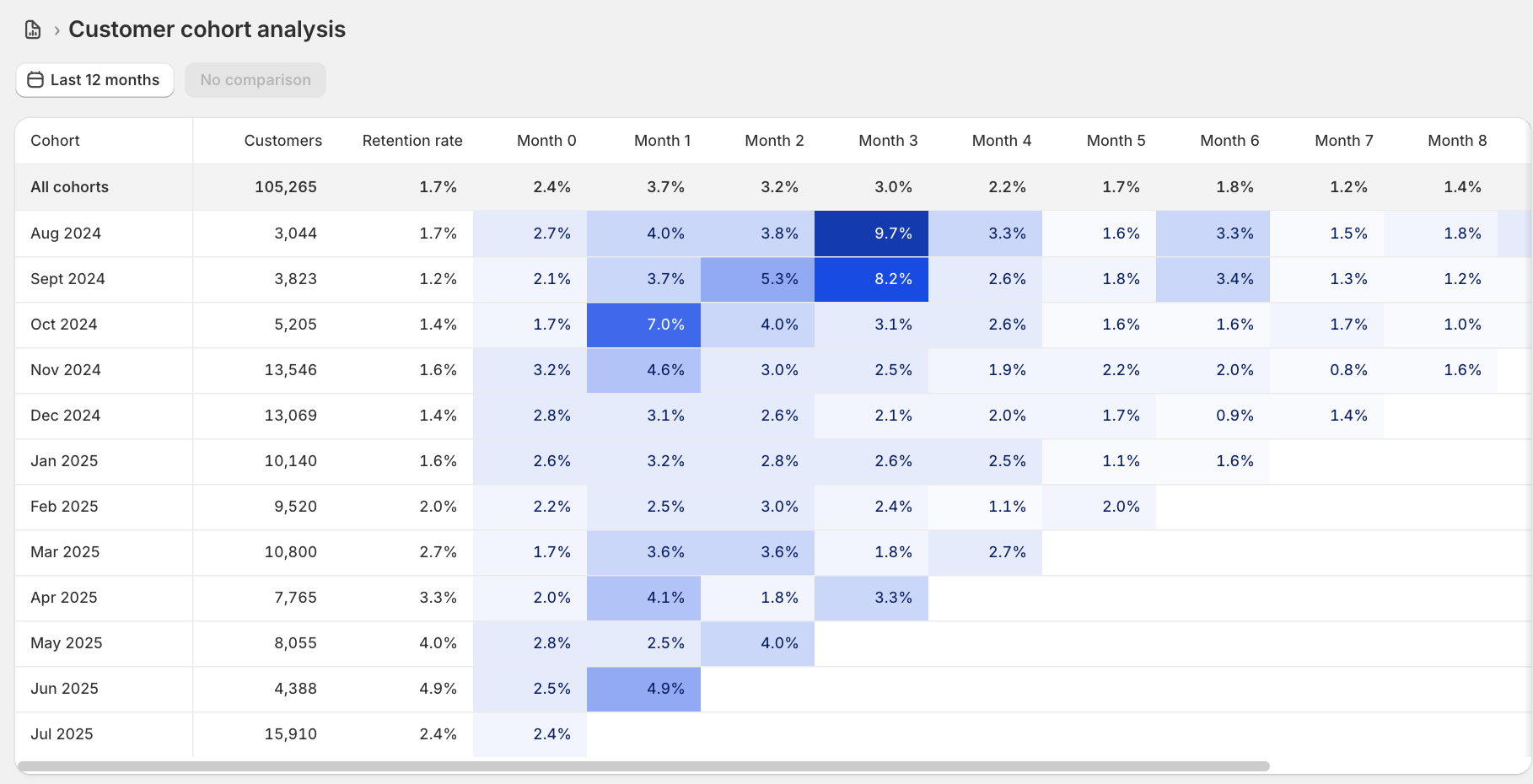
Cohort analysis by first product purchased showing month-over-month return rates. This is the report that reveals which products in the catalog actually build long-term customer relationships.
What changes based on your product type
The product the customer just bought determines what the flow should do next. This breaks down into three categories.
For consumable and replenishable products (supplements, skincare, pet food, coffee), the flow's job is to onboard the customer properly and time the replenishment nudge to match their actual usage cycle. Respect the purchase cycle. There's no need to push for a second purchase immediately.
For non-replenishable, high-ticket products (furniture, electronics, appliances, equipment), nobody is buying a second sofa 30 days later. The post-purchase flow still matters, and its job changes to three objectives:
1. Reduce returns and buyer's remorse.
A $2,000 purchase generates more post-purchase anxiety than a $30 one. The confidence email is even more critical. Care instructions, setup guides, styling inspiration for furniture, feature walkthroughs for electronics. Every email that helps the customer feel good about the purchase reduces the likelihood they send it back.
2. Cross-sell into complementary categories.
A customer who bought a dining table is a strong candidate for dining chairs, tableware, or lighting. A customer who bought a high-end camera is a candidate for lenses, bags, and editing software. The cross-sell logic should be category-based, not a generic "you might also like" carousel showing another dining table.
3. Build referral and advocacy.
When the repurchase cycle is measured in years, the most valuable action a post-purchase flow can drive is turning the customer into a referrer. Social proof requests, UGC prompts, and referral program invitations belong in the post-purchase flow for high-ticket products where the next revenue opportunity is more likely to come from the customer's network than from the customer themselves.
For products with no built-in LTV (one-time novelty items, single-use gifts), the post-purchase flow matters less because the product doesn't generate a second order. The focus should be on shortening the prospect-to-first-purchase funnel and maximizing the value of that single transaction through bundling and upsell at checkout.
A post-purchase flow that recommends the wrong product trains customers to buy once and leave. The flow should know what the customer bought and what logically follows from that purchase. Without that, you're guessing, and at scale, guessing compounds into lost revenue every day the flow runs.
How to run this audit
Export your customer data from Shopify. Group customers by their first product purchased. For each product group, calculate the returning customer rate at 30, 60, and 90 days. The products with the highest return rates at 90 days are your relationship starters. Build the post-purchase cross-sell logic around moving customers toward those products.
Product Intelligence Summary
Which products build retention and which ones end the relationship?
1
Does it lead to a second purchase?
Or does it complete the customer's need entirely?
2
Relationship starter or ender?
What % of first-time buyers of this product ever return?
3
What does the cohort data say?
30/60/90 day return rate by first product purchased.
Your Product Type Determines Your Flow Strategy
Consumable / Replenishable
Products with natural gravity
Supplements, skincare, pet food, coffee
Flow objective:
✔️ Onboard and educate on product use
✔️ Time replenishment to actual usage cycle
✔️ Respect the purchase cycle
Non-Replenishable / High-Ticket
Products bought once
Furniture, electronics, appliances, equipment
Flow objective:
✔️ Reduce returns and buyer's remorse
✔️ Cross-sell into complementary categories
✔️ Build referral and advocacy
No Built-In LTV
One-time products
Novelty items, single-use gifts, seasonal
Flow objective:
✔️ Maximize single transaction value
✔️ Bundle and upsell at checkout
✔️ Shorten prospect-to-purchase funnel
Chapter 4
Replenishment Timing: Why Fixed Windows Cost You Revenue
Replenishment triggers based on round numbers like 30, 60, or 90 days are almost always wrong. The actual time between orders should be pulled from Klaviyo Predictive Analytics at the profile level, then aggregated by product category. Brands that use real data instead of guesses can catch customers at peak re-order intent.
Most ecommerce brands set replenishment flow timing based on a round number. 30 days. 60 days. 90 days. These numbers feel reasonable. They are almost always wrong.
The actual time between orders varies by product, by category, and by customer segment. A 30-day default might be close for a daily-use supplement. It could be wildly off for a skincare product that lasts 45 days or a pet food bag that lasts 6 weeks depending on the size of the dog.
Guessing the window costs real revenue.
At Nuvé, the replenishment trigger was set at 75 days. When we pulled the actual data from Klaviyo's Predictive Analytics, the real average time between orders was 30 days.
That's 45 days of silence during the peak re-order window.
Nuvé: The Replenishment Timing Gap
45 days of silence during peak re-order intent
DAY 30
Customer ready to reorder
DAY 75
Email finally arrives
← 45 days of silence →
By the time the replenishment email landed, the customer had already reordered on their own, bought from a competitor, or moved on entirely. The fix was simple. Export the customer base, calculate the actual average time between orders, and reset the trigger to match.
How often should replenishment emails be sent?
Klaviyo's Predictive Analytics gives you the expected date of next order at the profile level. At the aggregate level, you can pull average time between orders across the full customer base or by product category.
The category-level view matters. Consumables and durables behave completely differently. A customer who buys protein powder every 28 days and a yoga mat every 18 months should not sit on the same replenishment trigger.
Your replenishment trigger and your winback trigger should be calibrated to the same data.
If the average time between orders is 30 days, the replenishment nudge should fire around Day 25. The winback flow should fire around Day 45. These two flows are connected.
The replenishment flow catches customers before they lapse. The winback flow catches the ones who slipped through. With Klaviyo's default timing on both, the odds are high that neither fires at the right moment.
Quick Setup Check
Open Klaviyo. Go to Analytics > Predictive Analytics. Look at "Average Time Between Orders" for your full list, then filter by product category. If the replenishment flow trigger doesn't match what you see there, repeat revenue is leaking every day it runs.

Chapter 5
Layering SMS Into Your Post-Purchase Flow as a Parallel Channel
SMS in a post-purchase flow runs as a separate channel with its own timing, angles, and segmentation logic. It earns its place by doing a different job than email, at a different moment, for the same customer. The brands generating meaningful SMS revenue test angles aggressively and gate everything by consent.
The brands generating meaningful revenue from SMS treat it as a separate channel with its own timing, its own angles, and its own segmentation logic.
The most common mistake is running SMS as an echo. The same message, the same day, just shorter. The customer receives both, recognizes the duplication, and starts ignoring one channel entirely.
SMS timing should be shorter than email timing.
SMS is an immediacy channel. Email is a depth channel. They serve different psychological functions in the post-purchase window.
At Cadenshae, email and SMS run in parallel in their Added to Cart flow. Email fires at 4 hours. SMS fires at 45 minutes. Two channels doing two different jobs at two different moments.
Angle testing matters more on SMS than on email.
On email, there's room to build an argument. On SMS, there's one or two sentences to land it.
Qure Skincare ran a test in their post-purchase SMS flow: a problem-solution angle against an offer-led angle. The problem-solution version won and became the #1 performing SMS flow in the account. The winning message addressed the customer's skin concern directly and positioned the product as the answer. The losing version led with the discount.
SMS consent gates everything.
The SMS post-purchase flow can only reach subscribers who have opted in, and consent rules vary by geography. Cadenshae's SMS triggers are gated to AU subscribers who are consented. A US-based brand will have different compliance requirements.
Build the flow for consented subscribers first. Start with the two or three highest-impact SMS touchpoints in the post-purchase window and expand from there based on performance.
SMS revenue doesn't show up in year one for most brands. The list needs to be built with the right opt-in, warmed correctly, and messaged with discipline.
At Fenix, SMS contributed 2% of total store revenue within 2 months of launch. Web push added 11% within 3 months. Combined with email, owned channel revenue reached 71%.
Garvee added 77K net new SMS subscribers in Q4 alone after rebuilding their multi-step SMS opt-in pop-up. That list created the foundation for every SMS-driven retention play that followed.
Where to Start
Pick two touchpoints only. A delivery check-in SMS (fires when the order is fulfilled, consented subscribers only) and one post-purchase SMS with a problem-solution angle timed 3 to 5 days after delivery. Test the angle. Measure placed order rate, not click rate. Expand from there.
Chapter 6
Behavioral Triggers That Lift Repeat Purchase Rate
The post-purchase triggers that move repeat purchase rate are product-specific and behavior-based. They fire based on what the customer did, not when the next send was scheduled. Education-led emails consistently outperform promotional sends in this window.
Calendar-based triggers (send Email 3 on Day 7, send Email 4 on Day 14) are easy to set up. They're also the reason most post-purchase flows plateau.
The highest-performing post-purchase emails we've seen are education emails, not promotional ones.
One anonymous pet accessories brand we manage runs two emails that outperform every promotional send in their sequence.
The first is an objection buster. It responds to the most common FAQs about their top products without offering any discount. Open rate: 65.10% against a 6-month account average of 46.77%. Revenue per send performed on par with emails offering 10-15% off, with zero discount cost.
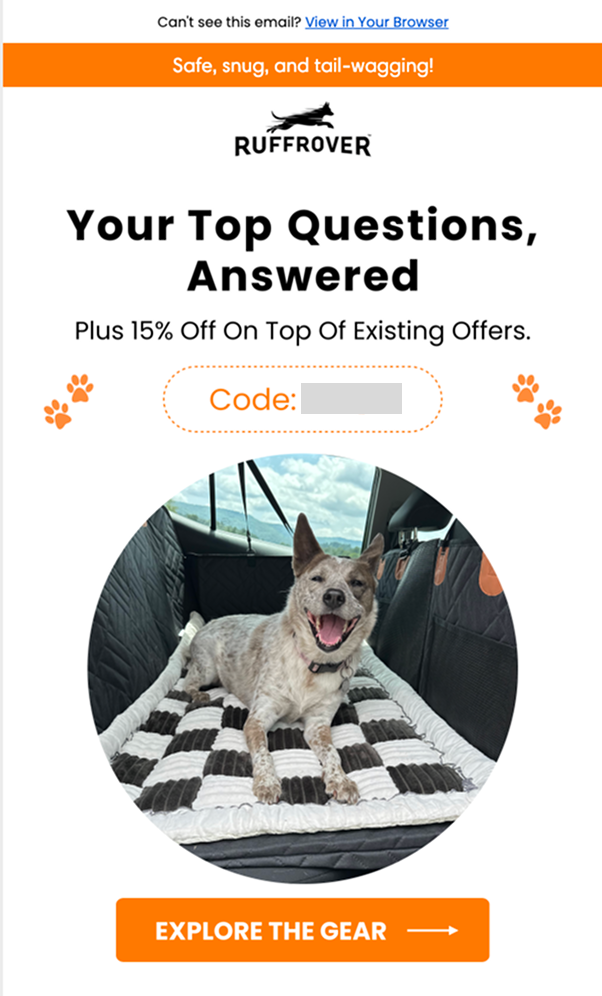
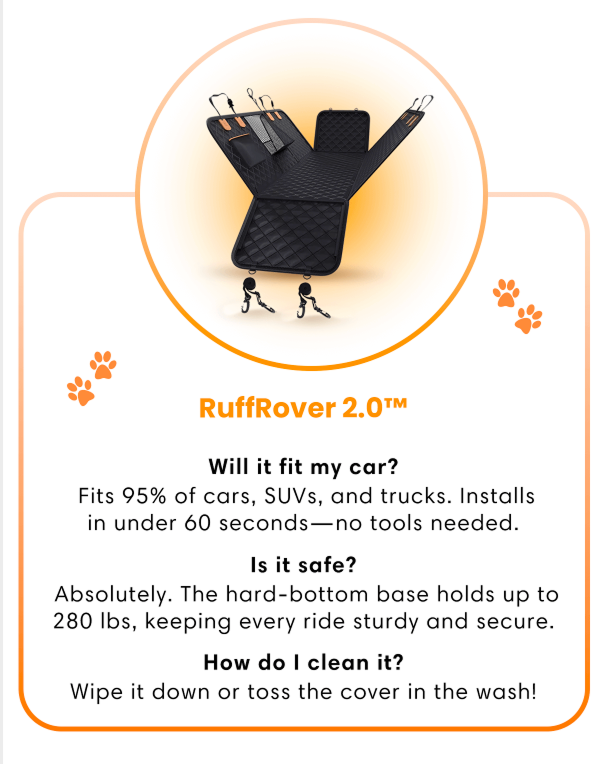
The objection buster email: 65.10% open rate, zero discount, revenue on par with 10-15% off promotional sends.
The second is an education email that addresses a real problem the customer has and ties it back to the product naturally, with a small 5% discount attached. Open rate: 61.66% against the same average. Revenue per send exceeded the 6-month campaign average by over 33%.
The education email: 61.66% open rate, revenue per send 33% above account average.
Both emails run once a month and perform consistently. The education angle holds because it addresses something the customer actually cares about.
The format itself is a lever most brands forget to pull
Education-led post-purchase copy doesn't have to look like a designed campaign. Sometimes the plain-text send outperforms the branded one. The pattern shows up again and again once format gets tested as a variable.
Here are two emails Fleava (a men's hair care brand we manage) sent in the same week. No discounts. No urgency. Same customer. Same education-led angle. Different formats.

Designed format. "The Science Behind Everything We Make." Open rate 58.61%. Top-3 revenue-generating campaign in the last 90 days.
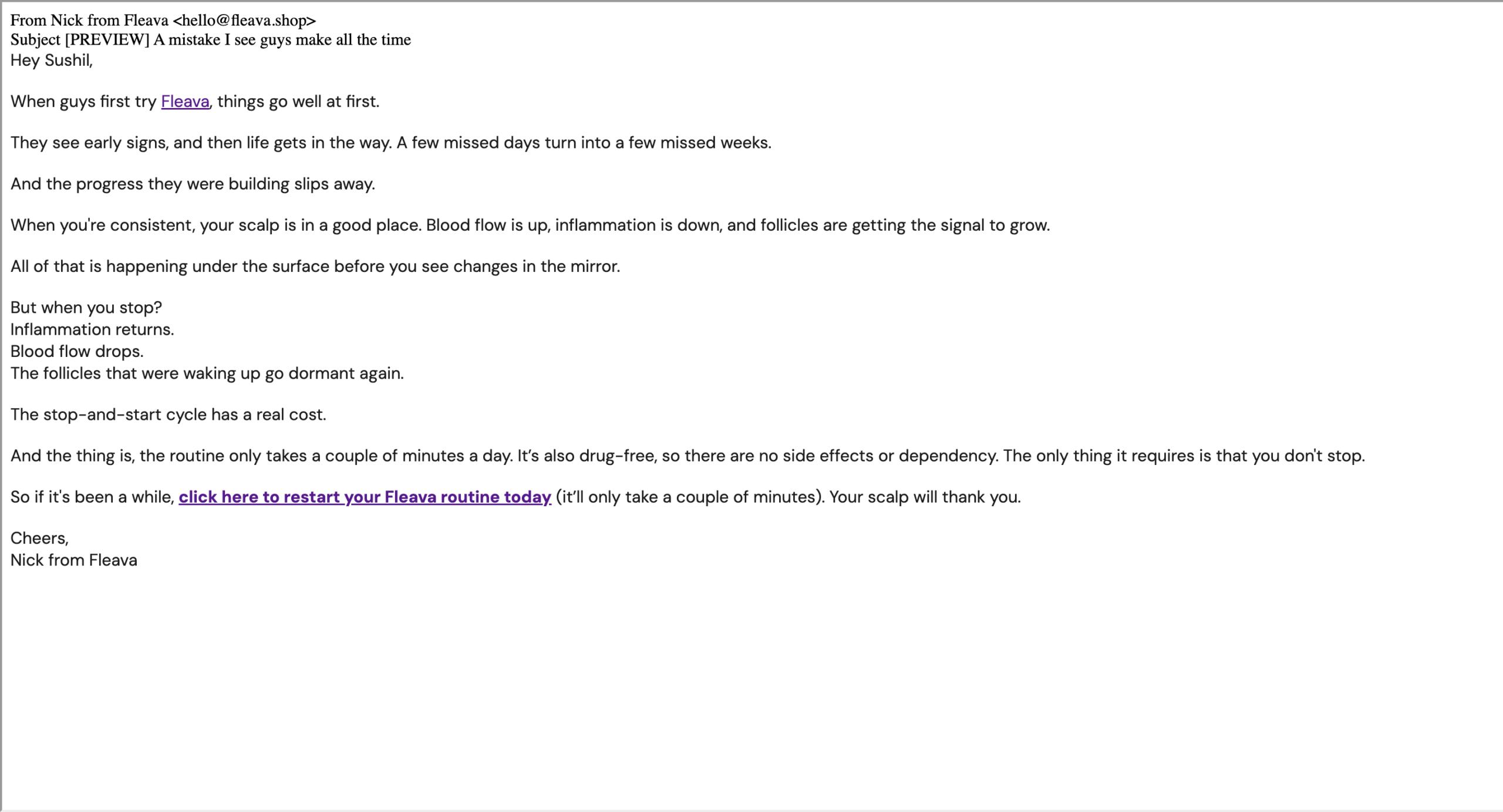
Plain-text format. "A mistake I see guys make all the time." Open rate 46.23%, click rate 0.93%, placed order rate 0.30%. Top-5 revenue-generating campaign in the last 90 days.
The designed version opens better. The plain-text version converts better. Both drove revenue purely through education. No discount, no urgency, no promo code.
Plain-text works in a post-purchase flow because it reads like a personal email, not a broadcast. It earns attention by looking like the sender actually typed it. When the content is genuinely educational and the customer already owns the product, that format matches the moment.
Most brands only test subject lines. The format of the email itself is the lever sitting untouched in almost every post-purchase flow we audit.
Run one designed education email and one plain-text education email against the same segment. The winner goes into the flow. The loser becomes a monthly campaign. Neither needs a discount to earn its keep.
Category-based trigger logic outperforms generic cross-sells.
Nature's Body uses benefit-led product categories as trigger logic inside their post-purchase flow. A customer who purchased from "Joint Health" receives a different post-purchase sequence than a customer who purchased from "Digestive."
The retarget data confirmed higher conversion rates on category-matched follow-ups.
Education-led post-purchase flows can drive premium AOV with zero discounting.
Austral Herbs generates an average order value of A$498 with zero discounting in their post-purchase sequence. Every email in the flow is education and outcome-led. No coupon codes. No urgency timers. No flash sales.
That AOV holds because the post-purchase flow builds confidence in the product and positions the next purchase as a logical step in the customer's routine.
Three trigger principles to apply to your post-purchase flow
1. Suppress the cross-sell if the customer hasn't opened the confidence email.
If they haven't engaged with the first post-purchase touchpoint, sending a cross-sell is premature. Add an engagement-based filter before any revenue-generating email in the flow.
2. Branch by product category, not just purchase history.
A customer's first product tells you what they care about. Use that signal to determine which cross-sell path they enter. Generic "recommended for you" logic based on site-wide bestsellers is a wasted touchpoint.
3. Use Klaviyo Predictive Analytics to time behavioral triggers to purchase frequency signals.
The expected next order date and average time between orders should inform when each email fires. A customer whose predicted next order is 14 days out should receive a different cadence than one whose predicted next order is 60 days out.

Chapter 7
The Flow Ecosystem Your Post-Purchase Sequence Sits Inside
A post-purchase flow operates inside a larger flow hierarchy that shares data, hands off subscribers, and adjusts based on where the customer came from. Welcome, cart recovery, browse recovery, post-purchase, repeat customer LTV, VIP, winback, and sunset are the standard sequence.
Most brands build flows one at a time. Welcome flow first. Cart recovery second. Browse abandonment third. Post-purchase eventually.
Each one gets built as a standalone automation with no awareness of what the other flows have already done.
The result is a set of disconnected automations talking past each other.
A customer who completed the welcome flow, abandoned checkout twice, and finally purchased should enter a different post-purchase experience than someone who bought on their first visit.
The first customer has been nurtured. They've seen the value proposition multiple times. They've hesitated and come back.
The second customer converted immediately and knows almost nothing about the brand beyond the product page that convinced them.
If both customers enter the same post-purchase flow and receive the same emails, the behavioral data already collected is wasted.
The flow hierarchy
At Chronos, every client account is built around a flow hierarchy that determines the order and relationship between automations:
Welcome → Cart/Checkout Recovery → Browse Recovery → Post Purchase (First Time) → Repeat Customer LTV → VIP → Winback → Sunset
Each flow in this sequence knows where the customer has been. When a customer finishes the welcome flow, that completion is recorded on their profile. When they finish checkout recovery, that's recorded too.
By the time they enter the post-purchase flow, the system already knows which flows they've been through and adjusts the experience accordingly.
Welcome
Cart / Checkout Recovery
Browse Recovery
Post Purchase (First Time)
Repeat Customer LTV
VIP
Winback
Sunset
What happens downstream
A subscriber who completed the welcome flow, the checkout flow, and the browse flow without purchasing enters a dedicated prospect nurture flow.
A first-time buyer who completes the post-purchase flow and hits 4+ orders with $300+ in total revenue enters the VIP flow.
At the other end, subscribers who stop engaging entirely move into a sunset flow that either re-engages them or removes them from the list to protect deliverability.
The connection that matters most for post-purchase
The post-purchase flow sits between acquisition and long-term retention. It receives customers from welcome and cart recovery. It feeds customers into VIP or winback.
Two questions worth asking: does your post-purchase flow know where the customer came from? And does it know where the customer should go next?
If the answer to either is no, the flow is disconnected from the system it should be powering.
Chapter 8
Post-Purchase Email Sequence Timeline: What to Send on Which Day
A standard post-purchase timeline opens with confidence and education (Days 0-3), moves to social proof (Day 7), runs the first cross-sell at Day 14, hits replenishment at Day 21 for consumables, and ends with category expansion or VIP invitation at Day 30. Exact timing should be calibrated to your average time between orders.
The architecture above can feel abstract until you see it mapped against a calendar. This is a simplified timeline showing what a properly built post-purchase flow does in its first 30 days.
The exact timing should be set by your own data, not copied from this table. The sequencing and the logic behind each touchpoint applies across product types.
| Day | SMS | Purpose | |
|---|---|---|---|
| 0 | Order confirmation + confidence | Delivery tracking | Reinforce the purchase decision |
| 1 | Product education / how-to | — | Build product competence |
| 3 | Usage tips / care guide | Check-in (consented only) | Reduce returns |
| 7 | Social proof / UGC | — | Validate the purchase |
| 10 | Non-opener re-engagement | — | Re-engage or suppress |
| 14 | Cross-sell (product-matched) | Cross-sell (different angle) | Expand the basket |
| 21 | Replenishment nudge (consumable) | — | Drive repeat purchase |
| 30 | Category expansion or VIP invite | — | Deepen the relationship |
Important Caveat
This timeline is illustrative. A brand selling a $15 supplement on a 28-day cycle will run a compressed version. A brand selling $2,000 furniture will stretch it out and replace the replenishment nudge with complementary category emails and referral prompts. The structure holds. The timing adapts.
Day 0 is about reinforcing the purchase decision. An order confirmation that reads like a receipt and nothing else wastes the highest-open-rate email in the entire program.
Days 1-3 are for education. Help the customer get more from what they paid for. Product guides, setup instructions, care tips. No selling. No review asks.
Day 7 is social proof. UGC, customer reviews, community content. The customer has had the product for a week. They've formed a first impression. Seeing other customers validate that impression reinforces the purchase.
Day 14 is the first cross-sell. Email and SMS run different angles. Both are product-matched based on what the customer originally bought.
Day 21 is the replenishment nudge for consumable products. Timed to actual average time between orders. For non-consumable products, this becomes a complementary category recommendation.
Day 30 is category expansion or VIP invitation. If the customer has purchased again, they may be approaching the VIP threshold (4+ orders, $300+ revenue). If they haven't, this email opens a new product category to keep the relationship alive.
Chapter 9
Frequently Asked Questions About Post-Purchase Flows
How many emails should a post-purchase flow have?
It depends on product complexity and purchase cycle. At Chronos, we build flows that run to Day 82 with behavioral branching, skin concern splits, and lifecycle integration. The minimum viable version is 4-5 emails in the first 14 days. Anything less than that and you're leaving the highest-intent window in the customer lifecycle mostly empty.
Should post-purchase flows include discounts?
They don't have to. Austral Herbs generates an average order value of A$498 with zero discounting in their post-purchase sequence. One anonymous pet accessories brand we manage runs an objection buster email with no discount that performs on par with emails offering 10-15% off. Discounts work, and they should be one tool in the mix.
When should SMS be added to a post-purchase flow?
When consent and subscriber volume support testing. Cadenshae runs email at 4 hours and SMS at 45 minutes with different messaging per channel. Start with two SMS touchpoints: a delivery check-in and one post-purchase message with a problem-solution angle. Measure placed order rate, not click rate.
How do you measure post-purchase flow performance?
Repeat purchase rate, customer retention rate, and flow revenue per recipient. Open rates and click rates tell you whether an email was interesting. They don't tell you whether the business is compounding. TheraICE saw a 153% increase in customer retention from a full lifecycle rebuild anchored by post-purchase.
What's the biggest mistake brands make with post-purchase flows?
Treating them as transactional. The post-purchase window is the highest-intent period in the customer lifecycle. Filling it with a single review request and a discount code wastes the cheapest retention window available to the business. The first email should build confidence in the purchase. Everything else follows from there.
Should I have separate post-purchase flows for first-time and repeat buyers?
Yes. A first-time buyer needs confidence and product education. A repeat buyer needs recognition and catalog expansion. Running one flow for both audiences means the messaging misses for everyone. In Klaviyo, the first-time flow triggers on Placed Order = 1 over all time. The repeat flow triggers on Placed Order ≥ 2.
How do I know which products to cross-sell in my post-purchase flow?
Run a three-question audit on every product in the catalog. Does this product lead to a second purchase, or does it complete the customer's need? Is it a relationship starter or a relationship ender? What does the repeat purchase data show for customers who bought this product first? Export your customer data from Shopify, group by first product purchased, and calculate the returning customer rate at 30, 60, and 90 days.
Get Your Post-Purchase Flow Audited Against This Architecture
The post-purchase window is the cheapest revenue opportunity in the entire business. The customer has already bought. They already trust the brand. They already have the product.
The system comes down to six decisions: split the flow for first-time and repeat buyers, build confidence before selling anything, identify which products start customer relationships, set replenishment timing from real data, run SMS as a parallel channel, and connect the flows so every automation knows where the customer came from.
Chronos has rebuilt this architecture across 500+ DTC brands at 8 to 9 figures. Book a free strategy call and we'll map your current post-purchase flow against the architecture in this guide and identify the specific gaps.